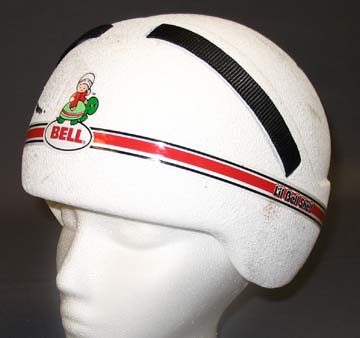
Aero road helmets are all the rage, and previously we covered the slick Giro Air Attack. Some riders, however, are unwilling to defy fashion trends, or are worried about the Texas heat in a helmet with so little ventilation. The LG Course aero road helmet comes to the rescue!
Based on appearance alone, it's hard to believe the Course could be as aero as Louis Garneau claims in their white paper, given that it looks very much like a normal road helmet. But some very good aero testing results have been coming in from ERO Sports. The helmet has tested fast on multiple riders; they report it consistently tested about 2% less drag (over the entire rider-bike system) than the Air Attack, and never slower. This included both aero positions and road bike positions. So we decided to check the helmet out.
We picked up a size Medium from ATC, and on close inspection you can see the trick with this helmet seems to be that it is basically letting the air pass straight through over your head and out the back again. Interestingly, this seems to make ventilation better than most normal road helmets, as both my wife and I noticed we could feel the breeze through our hair more with this helmet as compared to our usual ones. This, combined with carefully controlled frontal area, probably explains the surprising aero goodness. At 250g, the weight is also low, and it fits us both very comfortably. A really neat bonus feature is an included rear light that velcros onto the back of the helmet.
Integrated Rear Light Included
So we have a helmet that is light, aero, ventilated, and includes integrated safety features, but is there any catch? It is a bit more expensive than the Giro Air Attack and doesn't have the cool shield feature as an option. Also, both the white paper from LG and the testing at ERO Sports are lacking any high yaw data, so it is possible that the Course doesn't fare as well in crosswind situations as the Attack's smooth shape does. Overall, though, the Course is an amazing helmet that we recommend highly. ATC has them in stock now, so try it out yourself. The helmet is available in three sizes and in red, white, or black.
For a little over a year, the new breed of Mavic wheels has been on the market in the form of the CXR 80, a deep wheel with a bunch of unique features that has proved to be an excellent performer. The CXR 80 was the TT wheel of choice for the Garmin-Sharp pro cycling team, and has also been ridden with success in the local bike racing scene, even in crits. However, it's available only as a tubular, and is deeper than some people are comfortable with. Now a medium-depth version of the CXR line is here, the CXR 60, and it comes in clincher too! The key features of the CXR line of wheels include:
New Aerodynamic Shape
Mavic's CXR line takes a unique approach to wheel shape. Unlike the rest of the industry (which somehow simultaneously adopted "U" shaped rims), Mavic uses a combination of custom tires and a "blade" that fills in the space between tire and wheel to have complete control of the entire wheel-tire shape. If Mavic's wind tunnel results are accurate, this gives them a sizeable aero advantage over other wheels.
Downsides to this approach include a reliance on Mavic's custom tire, which may or may not have great rolling resistance to go with its excellent shape. If the rolling resistance is not good, it can more than offset the aerodynamic advantage. This is of particular concern in the tubular versions of the wheel, as the rolling resistance is not very good with that tire. Tom Anhalt has measured the rolling resistance of the Mavic clincher tire and thankfully found it has excellent rolling resistance, details here.
The other downside is dealing with the blades. The CX01 blade snaps into the rim after you install the tire. The process is quite simple, but would be an extra step to deal with when changing flats on training rides. On the other hand, you don't have to use the blades on training rides; you can save them for race day. Additionally, you need to take care that the brake pads are adjusted properly, or they could grab the blade when you apply the brakes. There have been a few reports of blades coming undone during bike races, possibly due to contact with other bikes. They can then get wrapped up in your hub and end your race. The blades might best be saved for time trials and triathlons, where bike-to-bike contact is rare.
While Mavic literature insists that the blades are only compatible with the Mavic tire, during our testing we used it along with the Continental GP4000S and experienced no issues or wear on the sidewall. The aerodynamic fit seems to be excellent as well (click to zoom):
CX01 Blade Fit with Mavic Tire
CX01 Blade Fit with GP4000S Tire
However, given the good rolling resistance of the Mavic clincher tire you may want to stick with it, especially up front. Exalith Braking Surface
The braking surface on the clincher version of these wheels is a special metal surface that Mavic calls Exalith 2. It has a directional texture, and is designed to work with a specific Mavic Exalith brake pad. The braking power and modulation on this is excellent, especially in the rain due to the texture feature. Our resident Cat 1 cyclist tester said she thought it felt better than her standard aluminum rims. While other racers get stressed out if there is rain in the forecast, you can remain calm and focus properly on your race, a nice advantage. The downside is the necessity of using the Mavic Exalith brake pad, which you may have to swap on and off if you use other wheels for training. In a pinch, other pads will work fine, but the Exalith surface seems to tear them up pretty quickly. You also must take care to orient your front wheel in the proper direction for optimum braking. We did test the braking with the wheel installed the wrong way around, however, and it still worked well.
The tubular version of the wheel uses a more traditional carbon braking surface. Aero Tuned Hubs The hubs on these wheels clearly have some aerodynamic thought put into them. The central section is as small as possible, and the flanges are also kept small and covered with smooth aero-shaped caps:
Real World Testing
Road testing revealed what we expected. Mavic wheels are very well built! There were no issues or drama under hard cornering or acceleration, and no flexing to cause the rear wheel to rub when pushing sickwatts up steep hills. We tested the wheels in a Cervelo S5 and a Litespeed C1 and found no clearance issues on either. Our resident Cat 1 cyclist Kat Hunter gave them a thumbs up, noting the exceptional braking performance. Meanwhile, our Cat 3/triathlete was able to decimate the local Strava scene in his neighborhood. Testing during windy days showed the wheels to be stable and predictable.
We noticed that the outer width of these wheels is quite wide, a bit wider that our HED Jets, in keeping with the current trend of sizing the wheel to match the width of 23mm tires. However, much of that width is used by the channel that you snap the CX01 blades into. The actual width of the rim from the tire's point of view is actually quite narrow. Rather than shaping the tire to fit the rim via extra wide bead hooks, Mavic uses the blade to provide a seamless tire to wheel transition. This design does make it a bit harder to work your tire onto the wheel. Below you can see the a blade, still snapped in place on the left, and the groove that the blades snap into on the right:
The construction of the clincher wheels is similar to HED Jets, with a carbon fairing attached to an aluminum rim. Mavic also applies a carbon fiber "cap" on top of the metal rim, however. The only exposed metal is the black Exalith braking surface and the black spokes.
Pricing and Availability
The CXR 60 will begin hitting Austin Tri-Cyclist (and other stores probably) in mid August. Pricing info will be in soon. Each wheelset includes a bunch of nice extras:
Giro has brought an aero road cycling helmet to market, the Giro Air Attack, a design meant to fall neatly in the aerodymanic middle ground between an all-out time trial helmet and a standard road helmet. That would imply that this helmet would save you about 15 seconds for every 25 miles you cover. Not a lot for the casual rider, but a good chunk of savings for the racer!
However, some are calling it an abomination, a sin against style committed by overzealous aerodynamic engineers. But is it really? For one thing, the smoother, tighter fitting shape is actually safer. The elongated shapes of most traditional helmets were actually introduced in the 1990s as a pseudo-aerodynamic feature, which made the helmet less safe, while the Giro Attack adheres to the more pragmatic smooth, minimal size design. Furthermore, one could argue that the Giro Attack is in fact the more traditional style, and the current beehive style of helmet is the true abomination. Let us look at history!
One of the earliest bike helmets circa 1980
Giro's first helmet! Look familiar?
1990's Helmets elongate, and get some vents
BEEHIVE!
As you can see, the Giro Air Attack is very much a return to tradition. If anyone gives you flack for your helmet, simply claim you are a retro kind of guy.
Features
Roc Loc® Air - This fit system suspends the helmet millimeters above your head to allow for ventilation and a precise, comfortable fit.
An optional polycarbonate, spherical shield mounts magnetically, enhances aerodynamics, and looks intimidating.
The helmet features X-STATIC padding with anti-microbial properties so your head doesn't get diseased!
Available in three sizes for optimum fit and minimal frontal area.
Can't decide if you want a stylish, boutique European brand, or a cleverly engineered North American bike? Boardman Bikes may solve the dilemma for you. Chris Boardman is an Olympic champion, three-time World Champion, and hour record holder. Those unfamiliar with his history of time trialing prowess and technical acumen both in training and bike design may enjoy this documentary. Unlike other brands that just pay to plaster a former pro's name on the bike, Boardman Bikes actually employs the person it touts on the downtube as the head of the company's Research and Development department.
So what has the Boardman brain trust produced? A line of time trial bikes that won the 2012 Kona Ironman World Championship, an aero road bike that won ITU triathlon gold and bronze at the 2012 London Olympics, a super-light sub 900 gram frame, and a whole line of road, mountain, and cyclocross excellence. Until now there was no way to get these bikes in the U.S. other than mail order. Austin Tri-Cyclist has brought Boardman Bikes to Texas, with models already in stock for you to test ride! We don't have the space to review every model that Boardman offers here, but we will give you a quick look at two of their coolest options:
The Kona Winning Boardman AiR/TT
Boardman AiR/TT/9.8
This is the time trial bike that Pete Jacobs rode to Kona victory last year. It features an overall shape very similar to a Cervelo P2, but with a trick fork that includes an integrated front brake and a hidden rear brake. Additionally, the stack and reach on these frames are lower and longer than the P2 or the new P3 and P5. Athletes who are frustrated with the high stack trend of some of the usual brands should give this frame a look. The AiR/TT comes in a variety of different builds and colors, all sharing the same frame and fork. The frame is CFD and wind tunnel designed, with a BB30 bottom bracket and internal cable routing. If you've been seeking a well-engineered TT bike, but want your ride to stand out from the crowd in the local transition racks, the Boardman is the ideal choice. Check out the video below for a tour of the bike's features from Chris Boardman himself:
The Gold and Bronze Medal Winning Boardman AiR Road Bike
Boardman AiR/9.4
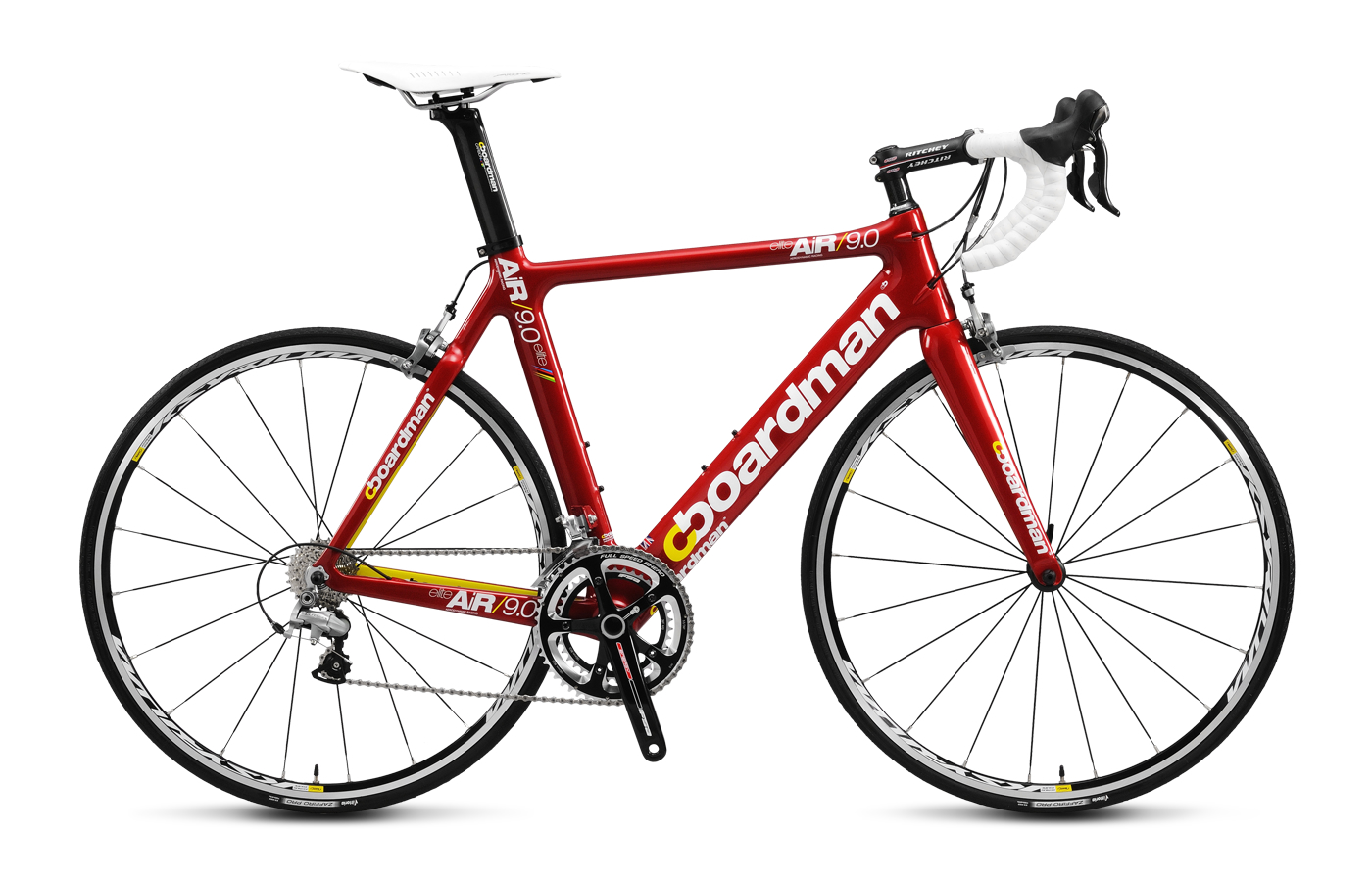
Aero road bikes have been catching on big time, and Boardman's AiR road frames have been proving themselves for years under the Brownlee brothers in draft-legal ITU triathlons. Numerous race wins, ITU world championships, and a gold and bronze medal at the 2012 London Olympics have established the bike's ability to go fast and handle well in a pack of triathletes going full gas. Like the TT frames, these road bikes offer lower, more aggressive geometry than other aero road frames such as the the Cervelo S5. They also build up light enough to weigh in under the UCI-legal limit of 15 pounds, even with aerodynamic wheels. The same design philosophy of the TT frame is applied to the road frame, with the stiff BB30 bottom bracket standard and internal cable routing to shave away aero drag. The road frame uses standard brake mounting for ease of maintenance and wheel changes. Again, many models and colors are offered, and all are based on the same frame, so you don't get shortchanged going with a less expensive model. Chris takes you on another tour:
The AiR 9.2S Field Tested
The Veloway Testing Grounds
I decided to put the aero road bike to the test up against one of the fastest bikes in the world, the Cervelo S5. The testing ground was the Austin Texas Veloway, a 3.2-mile loop featuring short, steep climbs; tight, technical turns; bumpy pavement; and fast, straight descents. The area is also somewhat shielded from the ever-present, gusty winds of Central Texas, which makes comparison easier.
I set the fit coordinates of each bike to be identical – saddle setback, saddle height, and the stack and reach of the bars. I then did a series of laps on the Veloway, alternating from one bike to the other. An important detail is that each run was done on the exact same set of wheels and tires: HED Jet clinchers with Continental GP4000S tires. Since wheels and tires can have a profound effect on speed, handling, and comfort, this is an essential, if annoying, step you must take when test riding or comparing bikes.
The Boardman felt great. I was immediately able to attack the corners just as confidently on the Boardman as I was on my own S5. Comparison with the super-cool Strava website Raceshape confirmed that the bikes were evenly matched around the hairpin turns. Up the steep, short kicker on each lap I would do a 1000-watt surge to get a feel for how the bikes felt at full power, and the Boardman proved to be plenty stiff and stable powering up the hill. The bike showed none of the uncomfortable properties some say they experience on aero road bikes, with everything feeling perfectly composed over the sometimes cracked and bumpy pavement at the Veloway.
GoldenCheetah's Aerolab
Virtual Elevation
A total of 6 laps were performed, a set of 2 with each bike at increasing power levels: the first at 200 watts, the second at 250 watts, and the third at 300 watts. I was careful to hold the same position with my head, body, and hands for each lap, and I wore a skinsuit to reduce the error that loose clothing can introduce. Using a clever method called the Chung Method, also known as Virtual Elevation, you can take power files from these runs and determine an approximation of the aerodynamic drag. Since public wind tunnel data is not available for the Boardman bikes, I was curious to see if they stacked up well to the known brands. While tests like this are fraught with error from imprecise body position and varying winds, 4 of the 6 runs produced fairly consistent results, suggesting that the Boardman was just a touch less aero than the S5, with a CdA about .005, or 50 grams @30mph more drag. This would put the Boardman AiR in the same ballpark as the Cervelo S2, or Specialized Venge, without tricky custom brakes or tire-limiting rear wheel cutouts. To put this in perspective, a typical round tube bike would come in at about 300 grams more drag than the S5. This test suggests definite aerodynamic legitimacy on the part of the Boardman AiR road bike.
Cervelo Rca - The lightest frame in the world goes aero
Cervelo has long been known for the aerodynamic prowess of their TT bikes and S-Series road frames. Despite this, the R-Series frames, their lighter and stiffer offerings, have been the most popular among both pros and amateurs. Though subjective qualities like comfort and lateral rigidity play a role in the wide appeal of the R-Series, a large part of the equation is that lightness is simply irresistible to the cycling enthusiast. Unlike aerodynamic claims, which are somewhat abstract and unverifiable to the average customer, a light bike can be directly experienced. You can hold it in your hand – or balanced lightly on one finger, if it's an Rca – and feel the difference.
Our 54cm frame came in at 630g
Cervelo operates a high-tech engineering lab called Project California, an underground R&D Batcave where they hand-build limited edition frames in order to explore and expand the boundaries of bike technology. In 2010, this facility produced the R5ca, a limited release version of their already super-light R5 frame, made crazy light with special carbon fiber layup and assembly tricks. Last month, crazy just got crazier. The latest limited edition frame from this top-secret nerd factory dropped the weight of the R-Series even further, to just 660 grams (on average), while also adding aerodynamic tube shapes and internal cable routing.
Now cyclists burning the midnight oil over the choice between aerodynamics and stiffness and weight can rest easy, able to have it all in one bike. The new aerodynamic features save 100 grams of drag (more than 7 free watts at 25 mph) compared to other high-end, non-aero road frames, making it about 1/3 as aero as an S5. The Rca, lighter than anything else on the market, also maintains all the stiffness of previous R frames. But for now, to own one you'll have to pay the big premium that comes with Project California frames, at around $10,000 for the frameset. Those of us with more modest bank accounts can look forward to the new aerodynamic "Squoval 3" tube shapes trickling down to the regular R-Series production frames in the very near future.
The BBright bottom bracket takes advantage of otherwise unused space on the non-drive side by using an asymmetric shape to increase stiffness and reduce the weight of the frame. Additionally, it allows cranksets to improve stiffness and/or weight as components have no external cups that they have to clear, allowing for straighter components with less curvature. In the end, the BB+crankset system as a whole can be designed stiffer and/or lighter. BBRight cranksets are available from many manufacturers such as Rotor, FSA, and SRAM, and others can be made to work with adapters.
Following in the footsteps of bikes like the Scott Foil and the new Madone, the Rca adopts "truncated" airfoil shapes in many of its tubes. At first glance they may seem like the same ovalized rectangles of previous R-Series frames, but if you look closely you can see the airfoil treatment that has been introduced. The new Squoval-3 shape manages to reduce drag by about 100 grams at 30mph compared to leading non-aero frames. That equates to about 1 second saved per kilometer at normal cycling speeds, 40 seconds over 40k, or more than 7 free watts at 25mph. Despite these new aerodynamic improvements, stiffness remains unchanged, and weight drops lower than ever before. You really do get to have your cake and eat it too!
When building up a beautiful, lightweight, aerodynamic bike, nothing makes one cringe more than having to zip tie or glue an accessory to it. That is exactly what you have to do in order to install popular crank-based power meters or cadence sensors on most bikes. The Cervelo Rca comes prepared, with an integrated magnet built into the bottom bracket area, saving you from these aerodynamic and aesthetic sins.
The Rca fork weighs in at just 300 grams before the steerer tube has been cut, meaning it will be well under 300 grams once it is fitted to your bike. This alone would be impressive, the result of clever engineering such as hollow, all-carbon dropouts instead of metal inserts. An additional feature on the Rca is entirely unique in the industry, however – a nanotech steerer tube coating. A point of much debate in cycling circles is the safety of carbon steerer tubes, which have to handle the stresses of riding as well as the clamping forces of stems, often overly tightened by owners. Carbon fiber is not as easily engineered to handle excessive clamping forces, but metal steerer tubes are not easily and safely merged into carbon forks, either. To solve this problem, Cervelo has used a new material licensed from 3M called "PowerMetal Nanovate." This 50 micron thick layer of nickel increases the "toughness" of the steerer tube, allowing Cervelo to make it light and safe.
Available now at ATC!
We currently have a 54cm frame in stock and ready for purchase, and can have other sizes ordered at your convenience. If you just want to see what a sub 12 pound bike feels like, and trust us it feels weird, come to our Barton Springs location and just ask!
It has always been "known" that if you want serious race wheels, you need tubulars. They roll smoother, handle better, can tolerate higher pressures, are lighter, and spin up better. All of these things have been basic truths of bicycle lore for decades. For those of us who would prefer not to scrape glue off of a rim when we get a flat, we have good news. Time trial specialist Tony Martin recently ignored these myths and rode a set of HED Jet clinchers to victory, defeating the legendary Fabian Cancellara to become world time trial champion in 2011.
Clinchers just as good as tubulars? A tough pill to swallow for most, even if Tony Martin says so. But the arrival of top notch clincher tires, latex tubes, and new clincher wheel offerings from HED, Zipp, and others has made it a reality whether the old guard believes it or not. The newest iteration of the HED Jet line brings improved aerodynamics and reduced weight, allowing you to have your cake and eat it too – you can change tires easily, but go just as fast.
HED's Jet line has always offered an affordable yet fast and high quality alternative to more expensive brands like Zipp, as well as the convenience of clinchers and aluminum brake tracks. The Jet wheels are built out of conventional metal rims, with the aerodynamic shape being created from a thin carbon fiber fairing. This means the wheels handle just like ordinary wheels and share the reliability and ease of maintenance of normal wheels, but cut through the air with a lot less drag. No more picking tubular glue off the rim, no more changing to carbon-specific race pads, just throw the wheels on and race.
2012 HED Jet Features
Improved Aerodynamic Shape
NEW for 2012 - The JET line gets a new shape, noticeable at first glance as the inside edge of the rim is much meatier. This has been the latest trend in aero wheel offerings, said to provide less drag and better stability in crosswinds. HED claims that the new shape gives the JET the same aerodynamic performance as their tubular Stinger line.
Unidirectional Carbon Fiber Skin
NEW for 2012 - The new unidirectional carbon is lighter and stronger, allowing for the new aerodynamic shaping, as well as reducing the weight of the skin by up to 54 grams. Above, you can see a closeup shot of a 2012 Jet 6 on the left compared to a 2011 Jet 9 on the right. Notice the thicker inner edge and different carbon style. Click for a closer view.
C2 Wide Rims - Jet Wheels continue to have an extra wide rim, which can help to improve handling and overall aerodynamic performance when the wheel is equipped with 23mm or wider tires. Road racers absolutely benefit from this feature, as they almost always run 23mm or wider tires. Triathletes and time trial specialists should keep in mind that even with these wide rims, narrower tires are still generally a faster option for races against the clock. Click the picture to see a closeup view of how a Zipp Tangente 23mm tire mates up with the wide rim on a Jet 6. Notice how the tire doesn't bulge out past the rim itself, for cleaner airflow.
Aluminum Brake Track - Few other aero wheels of this caliber offer the feel and convenience of a standard metal brake track. No longer do you have to engage in a ritual of brake pad swapping, or pray that it doesn't rain. These rims brake just like your training wheels, no special pads required.
Clincher Convenience - Got a flat in the middle of a stage race? Want to switch to a different tire because of rain? Can't resist the urge to train a bit on your race wheels? With tubular race wheels you are out of luck, with clinchers, just change the tire! Put on a super narrow, delicate tire for an olympic tri, and put a wider more durable one on for a rainy ironman. Tire selection is such a key part of overall bike performance that this can be a huge benefit.
Flamme Rouge - In the past you had to pay extra for the lightweight Flamme Rouge feature, but now most Jet wheels come standard with these beautiful carbon hubs that save a bit of weight and look pretty sweet.
Customization - HED can build wheels to suit your needs. Larger athletes can get stallion builds with extra spokes, an array of custom colors are available, and most of their wheels can be built with a Powertap hub upon request. Other options include track versions, 650c versions, and even wheels for recumbents. HED is even nice enough to ship their wheels with stickers that peel off cleanly and easily for those who prefer the stealth look.
Snapple-ATC's Kat Hunter will be on HED Jets for the Tour of the Gila 2012!
Aerodynamic Comparison
The following is a compilation of data from the HED Website for their 2012 Jet Clinchers. This is marketing data so use it at your own risk. It may be useful in comparing the relative differences between the HED Wheels, but these numbers are not comparable to wind tunnel results from other sources, as protocol details (tire choice, tunnel calibration, etc) could be completely different. Yaw angle is the angle of the wind as it hits the wheel. Very fast riders or windless days will be at lower yaw angles. Slower riders or very windy days will be at higher yaw angles. As a rough rule of thumb, each 50 grams of drag will save about 0.5 seconds per kilometer, or 20 seconds over 40k on a flat, straight course.
The HED Jet Lineup
HED currently offers the Jet lineup in a variety of sizes from shallow to all-out disc wheels. All wheels ship with skewers, rim tape, and valve extenders. Stop by ATC and give them a try!
The Union Cycliste Internationale, ruling party of all things bike racing, has been busy "clarifying" rules pertaining to bike design for most of its history. Frames and bike parts deemed legal for years are often found, quite suddenly, to be illegal. Recent victims have included the Specialized Transition, P4 water bottle, Cervelo seatposts, and the much-loved Vision time trial bars.
Growing weary of the changes and restrictions, which strike many as arbitrary and superficial, triathletes have campaigned for bikes that do not adhere to UCI rules, since most triathlons allow for much more design freedom. Bike makers have begun to answer the call. Spy pictures of a UCI-illegal "Illicito" from Quintana Roo have surfaced. Specialized had a brilliant release of the Shiv Tri, with Craig Alexander's Kona win as a fitting introduction. Now Cervelo has released their offering, the P5, which features a UCI-illegal fork, seatpost, and front end. But don't fear, roadies – there's a UCI-legal configuration as well.
Full details on the aerodynamic advancements have not been released yet (a whitepaper is coming) but the Cervelo website hints at the P5 being "30 seconds faster over 40k." It's not known if they are comparing the P5 Tri with the P4, but if so that would represent a significant leap forward, given that the P4 was already among the fastest, if not the fastest, bike on the market. The time savings implies that Cervelo may have trimmed another 75 grams of drag from the P4 to the P5, which would make it a complete outlier among bikes today.
Two Versions - UCI-Legal and Triathlon Specific
The Cervelo P5 frame is a completely UCI-legal and optimized shape. Several design features will appear similar to other recent super bikes such as the Scott Plasma 3 and Cannondale's prototype (currently being referred to as "the new Slice"). This is no accident, as the distinctive seat tube and head tube shapes are a logical consequence of the UCI's tube shape rules. Cervelo claims to have gone the farthest in maximizing these rules, resulting in deeper tube shapes in these regions than any other frame. The UCI-legal frame allows Cervelo to offer the bike in two configurations, one for triathletes and one for roadies. Those with the coin could even switch between configurations depending on the race. The UCI-illegal frameset comes with the following UCI-illegal bits to reduce drag even further:
A deeper, UCI-illegal fork that integrates with the Magura hydraulic aero brakes (~4 seconds per 40k time savings)
An aerodynamic, UCI-illegal front end cover for the front brakes (~3 seconds per 40k time savings)
A seat post allowing a more forward seat position adjustment
A custom, UCI-legal integrated aerobar, the 3T Aduro
Given that forks, head tubes, and aerobars sit up front hitting clean air, these changes should make for fairly large drag reductions compared to the UCI-legal frameset. The 3T Aduro offers the most potential advantage with its integrated design, adjustability, and water bottle mounting features. Fortunately, it's UCI legal, so roadies can use it too, though it doesn't come standard on the UCI-legal bike. Below you can see the P5 in three configurations, the standard UCI-legal bike with Magura aero brakes, the UCI-legal bike with a standard brake caliper, and the all-out triathlon setup (click to zoom):
Fit
The P5 frame features a bit more stack than the P3 in order to better accommodate the typical triathlete position. Those who prefer super low positions are not out of luck, however, as Cervelo assures the aero-minded that their 3T Aduro bar in X-Lo configuration allows lower positions than could be achieved on a P3 or P4. They claim the P5 allows more than enough adjustment to accommodate the entire Garmin team's positions, including Aero God Dave Zabriske. Cervelo has provided a stack and reach chart to aid in sorting out their new integrated aerobar system (below). When using the 3T Aduro bar, large stack adjustments are made with the 3 different configurations (X-Lo, Low, High-V). Fine tuning of the stack is done with under-stem spacers shaped to match the integrated stem. These under-stem spacers, once finalized, can not be adjusted much once the fork is cut to size. You can however make adjustments later with armpad riders. Any 3T, or Vision aero arm pad spacers will work.
Standard on Cervelo's S5 and R series bikes, the P5 is now the first TT bike to be offered with BBright. The BBright bottom bracket takes advantage of otherwise unused space on the non drive side by using an asymmetric shape to increase stiffness and reduce the weight of the frame. Additionally it allows cranksets to improve stiffness and/or weight as the non drive side crank arm can be straighter. In the end, the BB+Crankset system as a whole can be designed stiffer and/or lighter. The P5 will ship with Rotor 3D cranksets, and BBright cranks are currently available from SRAM, FSA, and Tune as well. Many other cranks can be made to work with adapters if desired.
Dropped Down Tube - Integrates with fork and front wheel +Click For Details
A feature carried over from the P4 is the dropped down tube. Cervelo combines an integrated fork that fits neatly into the frame and a dropped down tube that hugs closely to the front wheel. The design maintains an airfoil leading edge along this curve around the front wheel, rather than a cutout, which would add drag whenever the wheel is not pointed exactly straight ahead. On the Tri version of the P5, the UCI-illegal fork integrates seamlessly with the aero brakes for a beautifully integrated front end.
-The P4's integrated water bottle solution proved to not be very popular. The P5 has thus moved to the solution found on the S5, a truncated airfoil shape on the downtube that directs air around your water bottles, reducing the aero penalty of carrying a standard or aero water bottle.
-The P5 features mounting bolts on the top tube behind the stem, allowing for seamless and secure attachment of accessories of your choice, such as the P5 specific bento box from Dark Speed Works and a very slick, upcoming product from TorHans as well, to be released soon.
-The P5 offers a "HiddenPocket™" compartment behind the BB to store a Di2 Battery, and could perhaps be used to store a multitool or other small items as well with some modification (though rear wheel removal would be necessary to access it).
-The 3T Aduro aerobar includes mounts to place a water bottle between your aerobar pads, a hydration solution shown to often reduce drag significantly.
-A interesting bolt is visible on top of the BB area that may be present to allow integrated flat kit solutions to be mounted. TorHans is working on a product to fit seamlessly into this area, details to come soon.
Magura Hydraulic Brakes - Optimum aero and stopping power +Click For Details
This offering is a first for tri bikes. While the P5 will happily accept normal cable actuated brakes, the tri frameset and both complete bike offerings come with the new Magura hydraulic TT brakes. Magura has been building some of the best mountain bike brakes for years. Cervelo worked with Magura to design a road bike brake and brake lever that was as aerodynamic as possible. The hydraulic setup allows for an extremely aerodynamic brake, with all cables hidden from the air, without sacrificing stopping power or modulation. The brakes easily allow new wider rims to fit, offer easy adjustment and quick release, and have a 5 year warranty on fluid loss. Total weight is only 495 grams for the RT8 version, which includes the Cervelo-designed aero brake levers, and fluids. Those who don't wish to use the hydraulic brakes can still use any brake they like, as all mounting points are completely standard.
Easy Maintenance - Easy traveling, wheels fit, standard parts +Click For Details
While the front end of the P5 appears very proprietary, the entire bike can use normal parts at all locations. The front brake mount can accept any standard brake, the rear brake can accept standard calipers, and standard stems and aerobars can still be used. Assembly of the bike for travel is perfectly normal and requires no special tools or extra time. The Magura brakes allow for great aerodynamics without the usual difficulty of adjustment and wheel changes associated with center pull brakes. Cervelo also says that all current wheels on the market, including the extra wide wheels from Zipp and HED, fit in the P5 frame.
Included in the UCI-illegal frameset is the 3T Aduro aerobar. This is available in three configurations (X-Lo, Lo, and High-V), offering a wide range of stack to suit any rider. Cervelo claims that all three configurations are essentially identical aerodynamically, so there is no penalty for those who need more stack. Stack can be fine-tuned with integrated fork spacers, and reach is adjustable in a 5cm range. See the stack and reach chart above in the fit section for details. Cables are routed through the bar completely internally, never seeing the light of day as they enter the frame under the cover of the integrated stem. The Aduro also features a clever bottle mount system, so zip ties are no longer required to "torpedo mount" a bottle between your arms. The Aduro is not included in the UCI-legal bikes, but it is UCI legal, so roadies looking for the fastest setup may want to pick this up too. The X-Lo configuration of the Aduro features a very low stack, which allows for aggressive positions even though the P5 frame stack is higher than the P3 and P4. Cervelo also claims this is the fastest aerobar they have ever tested, and they have tested the much lauded Ventus and USE Tula.
Specs, Pricing, Availability - ATC expects stock to begin arriving in March
Four configurations of P5 are currently offered, framesets and complete bikes in "TT" and "Tri" configurations. Details and pricing follow:
Trim
Includes
Gruppo
Price
TT Frameset
UCI-legal fork and seatpost, mechanical rear aero brake
N/A
$4,500
TT Complete Bike
3D Rotor BBRight Cranks, 3T Aura Pro Aerobar, Magura Hydraulic Brakes +above
Dura-Ace/Ultegra
$6,000
Tri Frameset
UCI-illegal fork and seatpost, hydraulic brakes, 3T Aduro Aerobar