Austin Tri-Cyclist Blog

Showing posts with label time trial. Show all posts

Friday, September 19, 2014

BestBikeSplit.com
Texan Software Optimizing Your Bike Split

by Jack Mott

Back in June 2013, Dallas-based software company Best Bike Split quietly launched a groundbreaking new website, one that replaces the guesswork and superstition so inherent to time trialing with real data and real math. Taking inputs about the individual rider, bike, course, and weather conditions, the tool allows a user to predict finish times, optimize pacing plans, and make intelligent equipment selections. The data nerd can enter every last thing, from CdA to rolling resistance, but for the novice or less detail-oriented athlete, the software can also make intelligent guesses on many unknown minutiae. BBS has been used with great success by various local Austin professionals and top amateurs, including pro triathlete Kelly Williamson787 Racing's Steve Guzman, and ATC Racing's Kat Hunter, and the site continues to improve, offering new features regularly.

How Does It Work?

When you set up an account, you enter various personal statistics, such as your mass. You also set up a profile for each of your bikes, including the bike's mass and your aerodynamic drag on that bike.  If you don't have an estimate for your aero drag, BBS will estimate based on your height and weight and type of position. You can then upload a course you want to model from a GPS device or mapping software in .GPX format. Most popular TT and triathlon courses are likely already uploaded, and you can simply search for them and select them. From here, the magic of mathematics takes into account all your profile data, wind, corners, hills, and so on and allows you to answer pressing questions such as...

Optimal Pacing

A sample power pacing plan
Most people know that you need to go a little harder uphill and a little easier downhill to go as fast as possible for a given effort, but exactly how much to vary your power can be tricky to determine. BBS does the math for you to give you an exact answer. You can use the resulting pacing data in a number of ways: simply review it to get a high-level idea of how to vary your pace on key climbs, download the pacing plan to select GPS devices so that you have a second-by-second power goal as you race, or use BBS to output a simplified "cheat sheet" that you can memorize or tape on your top tube.

Sample Pacing Chart
Sample Cheat Sheet

Predicting Time or Power

If you have a goal time for your bike leg, like a sub hour 40k TT or 5-hour Ironman bike split, you can use the BBS goal time model to tell you what power you will have to generate on a given course to achieve it. Conversely, if you are trying to decide on a goal power for your event, you can use the regular pacing model to see what time will result at each power level.  For example, is it worth the risk to try going 20 watts harder in  your triathlon than last year? Find out exactly how much time it will save before you decide.

Optimize Equipment Selection

Yaw Angle Distribution
Challenging bike courses with lots of hills often leave athletes wondering if they should use a road bike instead of a TT bike, or light wheels instead of aero wheels. With BBS you can set up bike profiles for various options and do the math to fairly definitively decide which option is really best.  A great example of this being put to use is the Flo Cycling weight vs aero study. True aeroweenies can dig even deeper using the yaw distribution feature. This will give you data on the time you will spend at each yaw angle on course. Since the benefit of some equipment choices such as tire and wheel width depends on the yaw angle of the wind, you can use this to shave off seconds nobody else would even think about.

Optimize Your Position

The Wind Tunnel Model is an upcoming feature that will estimate your overall aerodynamic drag by analyzing your past performances. This will allow you to compare test sessions or races with different equipment or positions to see if you have managed to reduce your aero drag or rolling resistance.

How Accurate Is This?

BBS uses well-established cycling physics to make its computations. If provided with accurate input for the rider, course, and atmospheric conditions, it will produce very accurate output. Many amateurs have reported spooky accuracy even when using estimates for some inputs, such as their aero drag.  BBS also features a few case studies on their website.

Cost

BBS has free, premium, and coaching memberships available.  Premium membership unlocks unlimited bike profiles, unlimited course plan downloads, and advanced features. Coaching memberships allow you to keep profiles on all of your clients.  BBS also offers a pro-level analysis service, providing personal attention to ensure the accuracy of course and rider input, as well as increased processing power for more accurate course modeling, if necessary. Pricing plans are detailed here.

About Best Bike Split

Best Bike Split was co-founded by Ryan Cooper and Rich Harpel in June 2013 as an offshoot of their first company together, Optimized Training Labs, which uses advanced mathematics to create training plans for triathletes and runners. Ryan is a Ph.D. mathematician who specializes in optimization mathematics, while Rich’s background is in design and web development. The two met in Dallas while training for the 2006 Ironman Coeur d’Alene. Best Bike Split’s goal is to be the standard for predictive race modeling and analysis for triathletes and time-trialists racing with power meters.


Tuesday, June 10, 2014

2014 Texas State Time Trial Champion
Gear and Tech Specs

by Jack Mott


Being former or current multi-sport athletes in many cases, the ATC Racing women pride themselves on their time trialing prowess and put up impressive results at this year's Texas State Time Trial Championship. Katie Kantzes nailed a third place in the Eddy Merckx category, Marla Briley got second in category 3, and Kat Hunter took first place in Cat 1/2. (You can read Kat's race report on TexasBikeRacing.com.)

On Sunday, the team of Missy Ruthven (ATC owner), Maggi Finley, Marla Briley, and Kat Hunter backed up those impressive results with a 56:37, fastest women's time, in the team time trial.

To give you an idea of the attention to detail that goes into a winning time trial, we will break down all the gear, aero data, and power data of Kat Hunter's winning ride.


Bike Build Specs
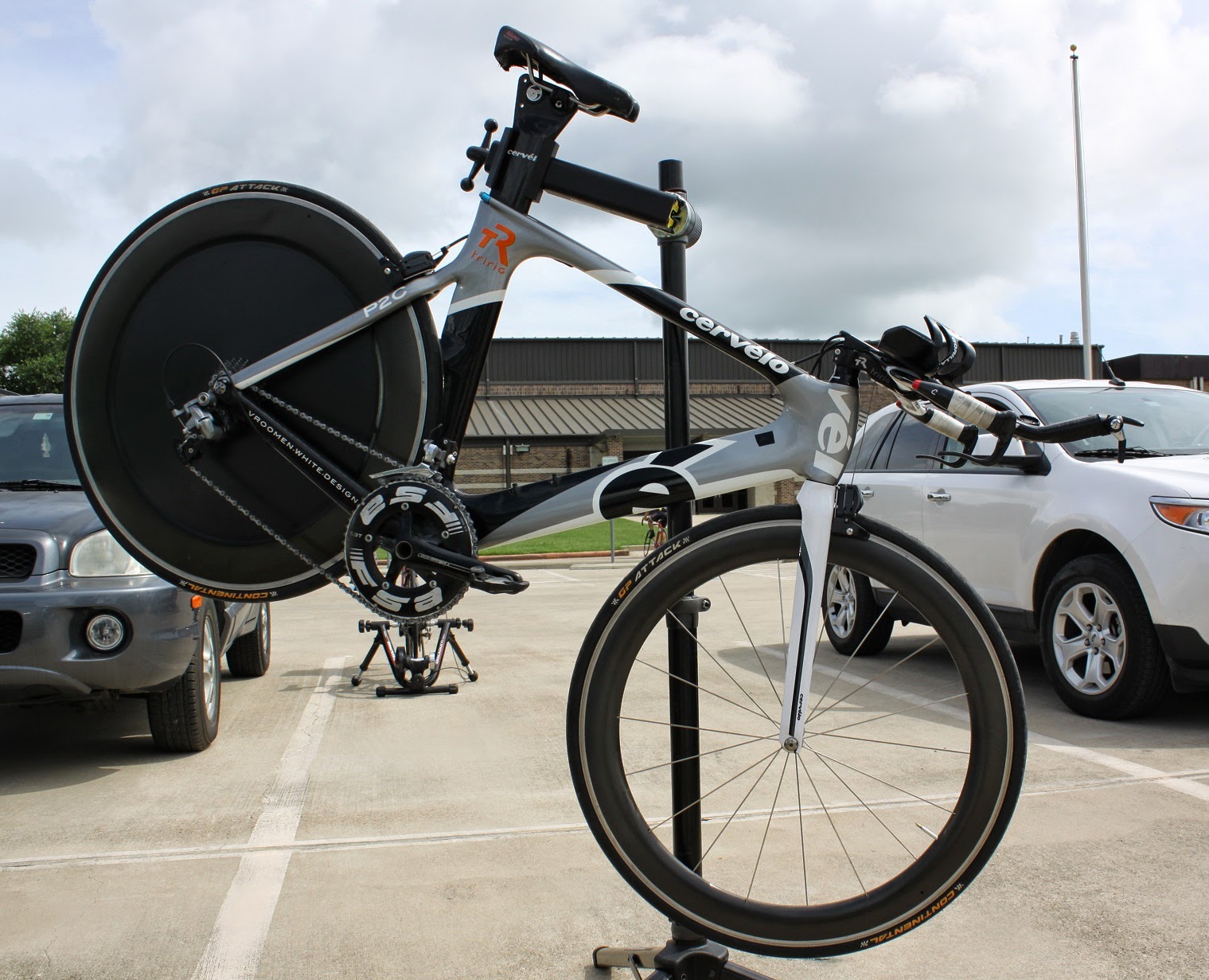
  • Frame - Cervelo P2C classic with modified top tube cable routing 
  • Wheels - HED Jet 6 front, HED Jet 9 with wheelbuilder disc cover and G3 Powertap hub
  • Tires - Continental Attack Clinchers, 22mm @ 105psi with Vittoria latex tubes
  • Aerobars - UCI Legal HED Corsair with integrated brake levers and Vision clipons
  • Stem - TriRig Sigma aero stem
  • Fork - Cervelo FK26
  • Brakes - TriRig Omega aero brake
  • Saddle - Adamo
  • Head Unit - Powertap Joule
  • Hydration - One between the arms rocket science bottle in a XLAB Gorilla cage
  • Skewers - View-Speed aero bolt on skewers
  • Helmet - Giro Selector
  • Cranks - FSA Gossamer with FSA 54T aero chainring
  • Pedals - Look Keo Blade aero pedal
  • Gruppo - Shimano Ultegra
  • Cassette - Shimano Dura Ace 12-25
  • Derailleur Pulleys - Hawk Racing
  • Bottom Bracket - Hawk Racing
  • Chain Lube - Rock n' Roll Extreme
  • Bar Tape - Tennis grip from Target. I dunno. It was thin.
Power Meter Data
  • Goal Power -  250 watts
  • Actual Average Power - 247 watts
  • Variability Index - 1.0
  • First Half Power (Headwind) - 254 watts
  • Second Half Power (Tailwind) - 241watts
  • Avg Temp - 82 deg G
  • Avg Cadence - 92
  • Avg Speed - 26.6 mph
  • Distance - 40k
  • Time - 56:23

Power File


WKO+ Power File from the TT

Aero Data

Approximate yaw angle distribution from BestBikeSplit.com


Using BestBikeSplit, an excellent online aerodynamic and pacing tool, we can approximate that Kat had a CdA of approximately .20 at 0 yaw, and .19 at yaw. We can also see that about 70% of the race was between 0 and 5 degrees of yaw, with most of the rest of the race between 10 and 15 degrees of yaw.  Knowing what the angle of attack of the wind is during a race can help you make intelligent equipment choices. For instance, we can see from this data that a deeper front wheel would have been faster, as around 30% of the race had yaw angles where a Jet 9 is a bit faster than a Jet 6.  Since about 70% of the race was at very low yaw angles,  choosing a narrower tire was definitely a good call. Narrow tends to be aero, at low yaw.

Close-up Bike Shots 

The venerable P2 Classic remains competitive

View Speed Skewers, Cervelo FK26 fork, and HED Jet 6 with Continental Attacks

HED Jet 9 with a disc cover taped on,  nice clean chain

TriRig brake, stem, and HED aerobars make for a clean front end


Wednesday, January 29, 2014

From “Fat Kid” to State TT Champion
A Profile of Nate Sheetz

By Kat Hunter


http://jahicks.zenfolio.com/
The average American seems to think of weight loss, or fitness in general, as a kind of destination—“There, I made it!” The truth is, of course, much harder. If there is a path to success, it looks sort of like the yellow brick road after an earthquake. There are ups and downs, bridges out, potholes as big as swimming pools. And there’s no end. If you make it to where you want to be and find yourself a nice, relaxing spot on the couch, you’ll wake up half a mile back down the road.

Eight years ago, Nate Sheetz, who stands about 5-foot-8, weighed more than 400 pounds. Last June, at 30 years old, he finished the 40K TT in 54 minutes and 44 seconds as the Cat 3 Texas State Time Trial Champion.

Nate’s path, particularly fraught with difficulty, is inspiring not only because of his accomplishment, but because of the unique patience and grace with which he weathered the worst obstacles along the way. Cycling is his passion, but not his job. A more ordinary person, after getting hit by a car—twice—and breaking almost as many ribs as are found in the human body, might have begun shopping for a new hobby.

In the Saddle
Most roadies get into the sport because they think they’re fast. In bike racing, the peloton already represents a talented segment of the cycling population; then there are those who stand out from that group, the riders who consistently do more than just hang on, who out-train and outperform the competition. Nate is one of those people, a natural, the kind of guy who can just put his head down and go hard forever.

When I ask him whether he had any indication of this aerobic talent growing up, Nate just says, “No, not really.”

Knowing what I do about Nate’s background, I'm expecting an emotional interview. Fat kid turned athlete? Accident victim back on the bike still wearing a neck brace? What hardship, what transformation! But what I soon realize is that I don’t really know Nate at all.

Every answer he gives me is to the point, matter of fact. I never get the sense that Nate is impressed by himself, which is strange even apart from his life story—the typical roadie is an irrepressible peacock. Nate has always been public with his quest to lose or maintain a certain weight, but he doesn’t wear his history like a badge or a chip on his shoulder.

Nate played team sports in YMCA programs as a young child, and then baseball and football in middle school. Outside of PE, however, that was the entirety of his experience in athletic competition before he began cycling. He was essentially sedentary after 10th grade. “I gained the weight steadily through my entire life,” he says. “I was a little bit of a fat kid and just got fatter and fatter for 25 years.”

“What I’ve often said about the entire weight loss project,” he says, “was the hard thing was deciding to do it.”

He began by counting calories and doing light physical activity, like walking up and down stairs. Some months later, he started lifting weights at the gym, followed by half an hour of cardio on the machines. He found the elliptical trainers tedious, however, and that’s when he began substituting time on the bike. He rode to and from the gym, adding on to make it a total of 8 or 10 miles.

It all spiraled from there, he says. Living and working in Berkeley, California, at the time, he began riding with a local group called Grizzly Peak Cyclists. “I found that I enjoyed cycling for fun, never mind the exercise,” he says.

Tour das Hugel 2012
Nate works as an ASIC design engineer at NVIDIA. About six months after he started riding as his main physical activity, he transferred within the company to take a job in Austin. He commuted to work by bike and went on rides with the Austin Cycling Association. Then, in 2010, he got bit by the Driveway bug.

When he heard about the Driveway Series, he told himself some day when he was faster he would think about racing it, but friends convinced him to bite the bullet. His first race was the Driveway 4/5 crit late that summer. He got dropped the first three weeks but found himself enjoying it, and eventually he began to hang on for the duration of the 30-minute race.

By 2011, he was somewhere between 200 and 230 pounds and was still steadily losing weight, but was working very hard to balance his diet with what he needed to fuel his workouts. He says his training at that point consisted mostly of group rides and riding around with people who were faster than him.

He tried a couple of different diets—for about five years, high protein, high fiber, and low fat being the key—but for the most part he was still counting calories. “That’s really the beginning and end of it,” he says. “You figure out what to eat that keeps you from being hungry all the time, while eating as few calories as you need to be able to lose weight.”

“Once I got to what would for a normal, non-insane person be a healthy weight and wanted to get down to race weight, that wasn’t working anymore,” he says. “I was just hungry all of the time.” Eating more carbs helped him feel better on the bike. By spring 2012, he’d hit a low of 168 pounds, and give or take a few pounds, was managing to stay there.

In the Hospital
Early on in his training, just after he’d moved to Austin, Nate had his first serious bike accident.  In September 2009, when he was commuting to work, a car turned left in front of him. With no time to stop, he smashed into the side of the car, breaking his left collar bone and completely rupturing the left AC joint. His injuries required surgery, which kept him off the road for three or four months. The recovery period undid much of his hard work.

“I gained a lot of weight,” he says. “I’d dialed back the food, but not enough.”

Eventually, however, he got back to where he was and then some. Training hard at the beginning of 2013, he was looking forward to the early season stage races and was as slim as he’d ever been. From his conversations with my husband, I knew that he was also hitting some of the best power numbers he’d ever seen. Having once gone on an incredibly tough 100-mile ride with Nate that had become 120 miles after a wrong turn, I knew what that meant. I felt sorry for the guys who’d be chasing him.

And then in February, he was on a training ride, going downhill on Veteran’s Drive toward the pedestrian bridge when a car pulled out of a parallel parking spot directly in front of him. In an instant, he went from roughly 25 mph to zero.

"Poster Child for Rule #5," February 2013
He was lucky to be alive. He had 14 broken ribs—12 on the right and 2 on the left—as well as a punctured lung, several broken vertebrae in his neck, and some minor back fractures. He was hospitalized for a week and a half and was put in a neck brace.

I ask him what it felt like to have gone from the best shape in his life to that state. In his typical, somewhat terse fashion, Nate says, “It sucked.”

But with a little prodding, he elaborates, talking about how he'd moved on. “I find it pretty easy to take an attitude of not crying over spilled milk,” he says. “I laid in the hospital and I knew my plans for the year needed to be radically altered, and I was pretty much at peace with it. I’m in the hospital one for two days thinking, you know, I bet I have time to be ready for the State TT if I just don’t worry about anything else before that.”

I was pregnant at the time of his accident, my due date about four months away. I remember thinking, given the extent of Nate’s injuries, that he was going to be back on the bike around the same time as me, and probably in worse shape. But one or two weeks after he went home from the hospital, Nate was on the trainer in his neck brace. He started with a 15-minute spin the first day, and then 30 minutes, 45 minutes, and so on, ramping very quickly back up to real workouts. When the collar was off in mid-April, he immediately got back on the road. His first ride outside was the 8.2-mile AllSports Mopac Time Trial, with a very respectable road bike time of 19:13 (25.6 mph). He returned to racing at the Driveway the following week. He was also at an all-time low of 160 pounds.

Most people would probably say he was crazy, but for Nate, the training was instinctive. “It’s not like I was pushing myself to get back on the bike,” he says. “It was like, ‘I need to start riding again or I’m going to go insane.’ I couldn’t wait to get back on the bike, and I couldn’t wait to start racing again once I was back on the road.”

Even the “sharp object lessons” in how badly he could get hurt didn’t change his desire to return to competition, he says.

Now that his injuries have healed and his surgeries are complete (he recently had a metal plate in his shoulder removed from the 2009 crash), he says there are no lasting effects post-accident that impact his riding. That is, with the exception of a slight difference in the depth of one side of his rib cage versus the other.  In true aeronerd fashion, he finds this annoying because he’s a centimeter higher in his TT position than he would otherwise be.

The State TT
Driveway Series 4/5, August 2012: 2nd Nate Sheetz, 3rd Vince Dietsch
Following the accident in February, Nate’s training goals were simple. He just needed to put in a lot of steady miles. He did plenty of that, but he also mixed in some fast-paced races and group rides.

“I went to the Driveway because it was fun,” he says. “I went to VOP because it’s fun. One thing I realized over the summer, when I was in Minnesota, is that I’ve decided it’s much better to have a 90% optimal training program that’s fun, versus a 100% optimal training program that’s no fun and you want to give up bike racing.” For a few months when he was in Minnesota, his home state, he spent much more time than he would have liked riding by himself on flat terrain.

He had more success at the end of the 2013 season than he’d ever had before. Racing for Austinbikes/Revenant in the cat 3 field, he won the Mineral Wells Time Trial on June 15, took second at Hotter’N Hell on August 24, and had his first mass-start win on September 8 at the Chappell Hill Road Race with a breakaway. But his result at the State TT on June 29 was the consummation of months of targeted hard work.

His intent going into the State TT was, of course, to win, but in the back of his mind, he was thinking a more realistic goal was to make the podium. However, after a refit on his TT bike from Sol Frost, he was more than a mile an hour faster having done nothing more than change his position. His confidence grew.

On race day, Nate viewed his biggest competition as Vince Dietsch (Austinbikes/Revenant), Ryan Coover (ENVE/Firefly Bicycles Racing), and Matt DeMartino (Team Yacht Club). Matt had missed the start time, Vince was his minute man, and Ryan Coover started just behind. Ryan passed him as early as 10K into the race, so was a concern, but Nate was holding him at a steady distance after, hoping to make a move at the end if Ryan didn’t blow up first. Then Ryan had a flat around 25K. At the halfway point, Nate could see that he’d made up some ground on Vince. Still behind Vince at the 5K mark, he hadn’t caught him, but it wasn’t a minute gap anymore. He knew he had it.

With a very fast time of 54 minutes and 44 seconds (27.2 mph), the State TT was Nate’s first major win (the breakaway at the Chappell Hill Road Race would come about three months later). His time stacked up well against some of the big names in Texas cycling. He would have been second in the cat 2s, only about 23 seconds off of Paul Carty (Austinbikes/Mobil 1); in the cat 1s, he would have been in sixth behind Gray Skinner (Big Sexy Racing).

Moving On
This year Nate is riding for VooDoo Racing, in quest of a final four points for his cat 2 upgrade, and is being coached by David Wenger.

Nate’s weight loss goals have varied over the years— “race weight” is a horse of another color, to be sure. Would he have lost the weight without cycling? Would he have taken it quite so far?

“The gym was always a chore for me,” he says. “Without finding a sport to get passionate about, I don’t know where I would have been. I probably would have kept it up, but not had much fun with it.” He certainly wouldn’t have pushed himself to lose as much of the weight, he says.  

For the bulk of the year, on top of his full-time job, Nate estimates he spends 20 or more hours a week cycling or doing bike-related activities. I ask him if all the time and effort he’s devoted and continues to devote to cycling seem worth it, if he ever has doubts.

“I love riding my bike,” he says, “and there’s a real sense of fulfillment and satisfaction in just trying to better yourself in general.” He says racing is the proof and the fruit of training, but the training itself, that process of striving to improve, is what he finds the most meaningful.

Everyone has their reasons for participating in a sport. Cycling is considered an unattractive pursuit by some because it’s time consuming, expensive, dangerous at times. It’s also very painful—day in and day out, whether it’s training intervals or the field sprint, you meet the weakest and strongest parts of yourself, the sane voice that screams for you to stop and the other one, the darker voice, that convinces you to keep going. But I think people do it because it’s that hard, because they think they can do something other people can’t, because those challenges become a part of who they are and how they see themselves. And that’s the thrill of it, more than the adrenaline rush—you’ve conquered yourself, molded yourself.  

I admire Nate a lot. No, he’s not a pro tour rider, or even a cat 1. His weight is still a constant struggle. But his work ethic is something that I think anyone, athlete or no, can esteem to. It takes a lot of courage to do what he did, changing everything about one’s life and body, and in his case, doing it in the unforgiving realm of skintight lycra and coldblooded competition.

Nate’s story makes me wonder how many other people in the world have it in them and just don’t know, hiding huge aerobic engines that would put the skinny kids to shame. What I sincerely hope for them is, someday soon, an opportunity to get on a bike, as well as the ability to recognize and embrace the potential for more.


Saturday, August 24, 2013

Pacing on the Bike

by Jack Mott
Missy Ruthven of ATC Racing finishing the Mopac TT

Position, power, and pacing are three keys to a solid time trial or triathlon bike leg performance. Obviously, you want to be capable of producing as much power as possible by training hard. We previously talked about position and equipment setup. Now let's talk about pacing. Optimal pacing gets you the most speed for your available energy. To a very close approximation, the best pacing strategy on a flat course is to hold constant power for the whole course. The most common mistake is to start out too hard because you feel good, which you pay for later.

40k TT - a little too hard the first half, but not bad
To illustrate the kind of time that can be wasted by bad pacing, we can run some numbers through the website Analytic Cycling. Suppose a 75kg rider is capable of producing 250 watts for an hour, and completes a flat 40k time trial with perfectly even pacing. This rider would complete the 40k in about 59 minutes and 24 seconds.  Now suppose that this rider makes the classic mistake of going out too hard and does 275 watts for the first 30 minutes, then starts to blow up and has to average 225 watts for the rest of the ride. This would result in a finishing time of 59 minutes and 32 seconds, about 8 seconds slower for the same average power.  That doesn't sound too bad, but in fact it would be impossible for the rider to maintain that power output of 225 watts after going out too hard.  The harder you push, the bigger the physiological price you pay, and if you start out too hard you will not be able to maintain the same average power.  A more realistic scenario is that the rider would have to drop down to something like 200 watts after starting out that hard, which would bump the time to 1 hour and 53 seconds. Almost a minute and a half slower.

So you don't have to have the new Cervelo P5 to see significant gains. You can potentially save more time by pacing properly than you can by upgrading your bike (of course, you could do both!). All you have to do is practice and ride smarter!  The most sure-fire way to nail your pacing perfectly is to use a power meter, but with practice you can do quite well without one. We will discuss how to approach both situations.

Pacing with Power

The first step to pacing an upcoming TT or triathlon bike leg is to pick a power goal.  For time trials, you should estimate about how long the event will take you to finish, and then look at your past power data to figure out what power you are likely to be able to do for that duration.  The Mean Maximal Power chart (or MMP) is very useful for this.  At a glance you can see what your best ever power production is for a given duration. For example, suppose you have an upcoming event that will take about 20 minutes.  Load up your MMP chart with some of your recent training history. In Golden Cheetah it will look something like this (WKO+ has a similar chart):

Click to Zoom
At a glance I can see that the best 20-minute power I've done is around 280 watts, but I can also see that there is a little bump around 17 minutes, where my best power is 300 watts.  This implies that I've never done an all-out 20-minute effort, and am probably capable of doing a little more than 280.  So a reasonable power goal might be 290 watts for the upcoming TT.  Be sure to take into account weather conditions and your fitness and fatigue levels when setting your goal. Hot weather will often lead to significantly less power, for instance.

Triathletes will usually want to set their power goals by doing practice bricks or by extrapolating from past races.  A great way to set a power goal is to do a bike ride that simulates race conditions as closely as possible, and then do a short run afterwards to be sure the pace left you fresh enough to run well.

Once you have your goal power, you don't want to follow it blindly on race day.  You might be capable of more, or you might have aimed to high. You need to listen to your body to some extent, but you also need to try to defy it sometimes when it tells you to slow down!  Since the most common mistakes are to start out too hard and to give up too soon, I like to use the following protocol:

1. For the first half of the event do not ever go above your goal power, but if you feel terrible, you may go under it.  This is especially important in the first few minutes.  It is okay to surge for 4 or 5 seconds to get up to speed, but then settle down, no matter how amazing you feel. It will pass, I promise.

2. For the second half, never go below your goal power, but if you feel great, start trying to raise it up gradually.  This ensures you won't totally miss out on any unexpected fitness or heroics.  We are all naturally capable of more than we think, so no matter how bad it hurts, never drop below that goal power in the second half, you can do it.

That is all there is to it. With this general approach you can almost guarantee you nail your bike legs and time trials every time. However, don't skip the section below where we talk about pacing without a power meter, because sometimes mechanical problems will leave you without your power meter, and you should be ready to perform well, and without stress, when that happens.

Pacing by Feel

The challenge with pacing by feel is the incredibly strong tendency to start out too hard.  The adrenaline of race day and your fresh anaerobic stores will leave you ready to go 100 watts or more too hard for the first few minutes, for which you will pay dearly later on.  Do not go out too hard. Do not go out too hard!

The most important thing you can do is practice. If you have a 40k event coming up, practice 40k TTs a few times. If you have a half iron race coming up, practice a 56-mile bike ride, evenly paced with as few stops as possible, and then run afterward.  Pay attention to the wind, your speed, and how you feel to get an idea if you have paced it well.  An evenly paced time trial will generally feel very easy for the first few minutes.  As you get near the halfway point, things will start to be very hard; you will not believe that you can keep up the effort the whole time.  After halfway begins the ultimate suffering that you must fight through and never give up. A well-paced triathlon bike leg will be quite different. Ultimate suffering should be avoided and used on the run instead!

With practice you will get to know what it feels like to pace evenly.  You can even borrow a power meter or use the CompuTrainers upstairs at ATC to practice.  If you do own a power meter, occasionally practice with the display covered by tape, and then review how you did after the fact. This will leave you capable and confident on race day even if something goes wrong with your power meter.

Pacing the Hills

Hills will disrupt the simple plan of holding even power. The proper approach to maximize speed on hills is to go a little harder on the uphills and a little easier on the downhills. The most common mistake is for people to launch out of the saddle and throw an extra 100 or 200 watts on the uphills. This is too much; instead, raise power by 20 to 50 watts depending on how steep the hill is, and lower it by about that much on the downhills.  For longer distance triathlons, consider putting a cap on your power output about equal to your threshold or one-hour power to ensure you don't dip into anaerobic reserves.  If you don't have a power meter, just remember to raise your power on the uphills, but don't hammer like a mad man. On the downhills don't give up and coast; keep a little bit of effort on the pedals and shift as necessary to keep moving well.  Again, longer distance triathletes may want to consider coasting on any decent downhill to conserve energy for the run to come. Time trialists and short distance triathletes should keep pedaling whenever possible!

Pacing the Wind

Wind follows the same pattern as hills, but to a much lesser degree.  The harder the headwind, the higher you should raise the power, and the stronger the tailwind, the more you should reduce your effort. However, the optimum change is very small, only 2 to 4 watts in either direction.  This is so small of a difference that it can be hard to put into practice even with a power meter, so you can feel free to just ignore it and pace evenly for the most part.  Exceptions include cases where the tailwind on one part of the course will be so strong that you run out of gear. In extreme cases like that, you will want to push much harder into the headwind since you will get a forced rest with the tailwind.


Wednesday, July 3, 2013

Race Report: 2013 State Team Time Trial Championships

by Allison Atkinson

ATC Racing lines up at the start
My morale was shot going into Sunday's Team TT. With the dark clouds of a disappointing individual performance looming from the day before, I reluctantly suited up, applied more chamois cream than normal, pumped up my tires to a hard 120 psi, and refilled my aero water bottle with the usual mix of lemon-lime Accelerade. After a quick warm up, I found my teammates, Anne Flanagan, Marla Briley, and Anne Stevenson.  We devoted plenty of hours to team practice and had a good strategy. My teammates would take their turn in the wind for 30 seconds each while I, because I am the biggest, would take longer, one-minute pulls at the same pace. Putting emotions aside became easier as we lined up to start.

The team did not want me to get burnt out. Every bit of recovery between pulls makes a huge impact on overall speed; therefore, I lined up behind Anne S., as she is the next tallest, thus offering more of a draft. We took off and quickly formed a tight line.  When it was my turn to pull, I stayed 30 watts above my average watts from the previous day's individual effort.  290-300 watts for one minute felt good. I drifted to the back for recovery.

Feeling a real need for our team to not only win the Cat 3 title but to get the best overall team time for the women, I became anxious. I knew that Jubilee Subaru and Think Finance would bring their "A" game, so we absolutely had to do the same. Maybe we're not pushing hard enough, I thought. I believe I made the mistake of going out too easy, so subsequently, my watts shot up to 300-400 on each pullnot part of the plan.  After drilling up a false flat, I heard Marla yell, "Gap!" The group fell apart, so I sat up until everyone was back on.  

I realized that I was hurting my team by failing to stay steady. I wanted to win so badlyinstead of sticking to the plan we practiced, I let the mistakes I made from the previous day selfishly determine the way I rode. As I retreated to the back of the line, Marla remarked, "The second half will hurt way more." I eased off as we approached the U-turn, where both Marla and I forgot to get into easier gears. We mashed, up out of the saddle, up to Anne F. and Anne S. to regroup.  

Settling back into my saddle felt like trying to get comfortable on a bed of stabbing needles, so I did my best to tune out my body's longings for comfort. The pain went away when torrential rain began pounding out of nowhere. Winds howled and thunder boomed.  Between the weather conditions and the fact that  it's tough to hear anything besides the whooshing wind inside an aero helmet, we could barely communicate or keep formation. 

Rain?  Really? It was almost impossible to see anything, especially when following a wheel closely. Rooster tails of nasty water flew into my mouth as I breathed heavily from mashing my pedals to fight the winds. It was after a few minutes when we regrouped and adjusted to the drastic change that an intense feeling of trepidation began to grow inside. I started thinking about my tire pressure, how slick my race tires were, and how much I was being blown around from my disc wheel. I started wondering how slick the roads were and whether we appeared visible to the oversized trucks that flew past. 

I will admit that I spent the first 10 minutes of rain clutching the grips of my base bar, bracing my entire core every time a gust of wind blew. I was inspired by Anne who, despite having the least experience on a TT bike, rode down in aero position the entire time!  I trusted my bike, teammates, and skills enough to eventually get down because the relentless headwind undoubtedly impacted speed. Settling into my aero bars, I found that I had more control in the crosswinds than I did sitting up. 

Conditions blew apart many teamswe must have passed half a dozen dropped riders. Roads were flooded in some areas, with muddy water at least four inches deep. The final left turn was a bit tricky.  I believe that was the point where we ALMOST lost Marla.  I looked back after leading us through the turn fast and saw Marla at what seemed like a dead stop.  We soft pedaled till she caught on again.  

"I'm not tired or anythingI feel great!" she yelled as she roared past. "I'm just scared!"  

"Don't be scared!" I shouted automatically.

I thought about the very wet road race that was part of the Joe Martin Stage Race earlier this year.  The Joe Martin course was hillier and had very technical descents, but I still pulled out a win.  I remembered paralyzing fear radiating from my chest every time I approached a descent. Still, my dread of failure and desire to win outweighed my crashing phobia.
State champs Allison Atkinson, Marla Briley, Anne Flanagan & Anne Stevenson
It is possible to be scared and strong at the same time.  No quitting allowed, no matter whatWe all wanted to win. Somewhere in the distance we saw signs of the finish and held a quick, steady pace to cross the linewhat a relief.  All I could say to my teammates was, "Dude, that was EPIC. I love rain!".

Team time trials have got to be one of the hardest events in cyclingyou either think that you are the weakest link or that you are superman. In the end it really is a race a truth, a true reflection of a team's strength though unity. I'm so proud of us for meeting our goal of clocking the day's fastest women's time and becoming this year's Cat 3 state champions!     

Visit ATC Racing's Website   

Tuesday, July 3, 2012

2012 Texas State Time Trial Championship

by Jack Mott

This past weekend was the annual Texas State Time Trial Championship. Hosted the last two years in Lytle, Texas near San Antonio, it features a 40 kilometer out and back course with rolling hills and smooth pavement. Each year the fastest athletes in the state test their time trial skills and aero equipment in hopes of winning a coveted state championship jersey, and cash prizes of course.

Kickstand Racing, who has been running the event of late, has paralympic categories, multisport categories, and an Eddy Merckx (non aero) category along with the usual roadie categories. The multisport category makes the event perfect for triathletes to test their bike skills and win some money in the process. It is also a great way to check out the positions and equipment of the roadie studs, which can often be instructive for new triathletes.

Riders are sent off at 30 seconds intervals, grouped by category. Drafting is not allowed. The course is rather simple with no technical turns other than the turnaround at half way. It is open to traffic but there is a sizable shoulder the entire length of the course. Saturday features all of the individual categories, while Sunday hosts team time trial competitions, where teams of 3 or 4 must carefully work together to go even faster.

The weather this year was hot, as usual, and a bit windy which is also the norm in central Texas. In the Category 1 men ranks, the favorites were 787 Racing's Brant Speed and Super Squadra's David Wenger who were 3rd and 5th respectively at Nationals just a few weeks before. As the Cat 1 men were finishing it became clear that the course was almost a kilometer too long. In the end Brant Speed came away with the win, with an average speed of nearly 30 miles per hour and a full minute ahead of 2nd place Logan Hutchings. David Wenger would end up fourth.

In the Women's category 1, Snapple-ATC TT specialist Kat Hunter was the favorite with Jenny Park of Team Brain and Spine and Jenn Mix of Team 787 gunning to upset her. Kat managed to hold them off and take the win with a time of 59:25 after holding an average of 240 watts for the 40+ kilometer course. She was aboard her Cervelo P2, with HED Jet clincher wheels and a brand new super fast Continental Supersonic 20mm front tire thanks to Kaleb West at ATC. Other trick equipment included the new Omega aero brake up front, a very cool new piece. Men be warned: the women in this event were cycling at 25+ mph for an hour

Browsing through the pictures of the competitors a clear pattern emerges. The people going fast are talented, and hard working, and they extend that hard work into their position on the bike. They have spent time figuring out how to get low and powerful, and even focus on how they hold their head through the course. In the time trial, the wind and your pain are the only enemies, and they must both be conquered. Triathletes can learn a lot by watching the top road cyclists in a TT.

On Sunday one of the more fascinating cycling disciplines takes place with the team time trials. These contests are fascinating due to their complexity and the high speeds that are achieved. Teammates fly along the road at over 30mph, wheels just inches from one another, hands in the aero bars away from the brake levers. Perfecting the timing of when each teammate should pull requires thought and practice. The top teams are ones with great athletes who have also put in the time to practice. In the men's top category, team Think Finance took the victory. They were the only top team present at the Mineral Wells team time trial a couple weeks before, and their dedication was rewarded with a state championship.

In the men's category 4, a victory for the triathletes as team Jockstrap Catapult of Houston narrowly bested team Ghisallo by 14 seconds with a 54 minute effort. Team Ghisallo did avenge this shame with overall wins in both the Category 4 and Eddy Merckx individual categories by Matt "Baby Jan" DeMartino and Adam Butler respectively.

In the most important race of all, the Category 4 Slowtwitch bragging rights contest, your author, Jack Mott, bested Charlie Buser by over 2 minutes in route to breaking the hour barrier for the first time, but still slower than his own wife.

Full TT Results Here (Scroll to the bottom)

Monday, May 9, 2011

The 40k Time Trial
An Hour of Power, an Hour of Pain


The History

Time trialing began in the late 1800s in England as a response to a national ban on road racing. At the time, instead of conflicts being between cyclists and cars as they are today, it was often cyclists and people on horseback. After some accidents and subsequent complaints, cyclists in England were in danger of being banned from the roads completely, and racers were seen as a threat that could inspire legal action against all cyclists. To prevent that eventuality, the National Cyclists' Union prohibited racing on the road, hoping to keep the races to the velodrome, just as car enthusiasts today encourage kids to keep the racing on the track. Few velodromes existed, however, so underground organizations formed and began a new racing format that they hoped would not attract so much attention.

The first time trial on public roads may have been in 1895, when Frederick Thomas Bidlake organized a 50-mile race against the clock. Drafting was not yet against the rules in these races, but riders were set out at 2- or 3-minute intervals, with the fastest going first, so drafting was unlikely to occur.

Over time these events evolved into races of 10, 25, 50, and 100 miles, with records being tracked for each one. That 25-mile distance, when converted to the metric 40 kilometers (24.85 miles), would become the 40k TT we know today.

The Significance

Perhaps by accident, or perhaps inevitably, the 40k TT comes up again and again as a relevant and important distance not just in cycling, but in triathlon as well.

  • State and National Championships - The 40k TT is often the standard distance used in regional and national time trial championships. Any cyclist interested in winning the yearly TT championships in his or her category will have to focus on this distance. In some regions the women do a shorter distance, but in Texas, women do the same course (because Texas is awesome).
  • The Gold Standard - The Hour - In days gone by, when the 40K was actually 25 miles, and when time trial bikes had round steel tubes and bullhorn bars and wheels had spokes, going under an hour for 40k was seen as a gold standard for cyclists. If you could do that, you were serious business. Since then, equipment has come a long way, and a sub-hour 40k won't even always win a cat 5 TT. However, for triathletes, who spend a large portion of their training time running and have to carry around an upper body that is actually useful so they can swim, breaking an hour is still a gold standard. Going sub-hour is proof of studly-ness (on the bike, at least), especially if done in the course of an Olympic distance triathlon (but only if you don't blow up on the run).
  • Functional Threshold Power (FTP) - FTP is defined as the amount of power a cyclist can average for one hour. This happens to be an interesting physiological power level, as it represents the crossover point between an almost entirely aerobic power output, and a power output that starts eating into anaerobic reserves that will eventually fatigue you. Cruise around at slightly less than your FTP and you can go for a long, long time. Cruise around slightly above it and you will soon blow up. Many coaches and athletes use this metric to set up training zones. There are many ways to estimate your FTP but the one way to get it exactly right? Go as hard as you can for an hour. For most people, a 40k TT and a power meter will be the best way to do that. To geek out further - Go Here.
  • Olympic-Distance Triathlon - One of the most popular distances in triathlon is the Olympic distance, when it first starts to get serious. The bike leg here is 40k, with a 1,500m swim before and a 10k run after. Age group athletes who can break an hour mid race have a good chance of starting the run in the lead. Also, while they rarely time trial it solo, ITU athletes making their bid for the Olympic games also bike this distance in their draft legal format.

Where to Race in Texas

  • Iron Haus Time Trial Series - First Saturday of each month - Great out and back course with a wide shoulder the whole way. Located just west of San Antonio in Castroville Texas. You only need to touch the brakes once at the turnaround. It's an informal event, so you can sign up online or the morning of.
  • Horse Country TT Series - May 14 and July 17 - Located in Aubrey, TX, this TT course features smooth roads, wide shoulders, and a bit of climbing.
  • CapTex Triathlon - May 30 - One of the biggest triathlons in Texas. The CapTex bike course is in downtown Austin. It is a twisty, crowded, multiple-loop course that will test your handling skills as well as your threshold power. Somehow this course remains fast despite the turns and crowds, perhaps due to the constant draft affect of passing slower waves.
  • Mineral Wells Summer TT - June 25 and 26 - Event still tentative, check the link for updates
  • Marble Falls Triathlon - July 17 - A wee bit short of 40k at 23 miles, but another beautiful bike course with no loops and no crowds. A big uphill to start things off and a fast downhill to finish it.
  • The Small Texan Triathlon - July 24 - Is 40k not quite enough? Runner studs got you down? This smaller event in Boerne, Texas, just outside of San Antonio, adds an extra 5k to the bike course for this otherwise Olympic-distance event. It will be hot, there will be no shade, but there will be a great course with beautiful water to swim in before you bike.
  • Texas State Time Trial Championships - July 30-31 - Details TBD but this event usually takes place somewhere in Central Texas near San Antonio. Anyone can sign up and they even include a multisport category for triathletes and duathletes. There is also a team competition the following day.
  • The Austin Triathlon - Sept 5th - Another huge event with tons of quality competition, The Austin Triathlon takes place in the same location as CapTex with slightly different courses. The 40k bike has the same challenges of twists and traffic, with multiple loops.
  • The Houston Triathlon - Sept 25 - A standard distance event near Houston.


Tips

A 40k Time Trial is an exercise in pain and patience. Athletes who go out too enthusiastically will explode enormously. The best way to pace it is an even effort with perhaps a little kick in the closing minutes. It takes great pain tolerance to keep that effort up all the way through. A bike computer can help you pace if the course is flat and winds are low. A power meter is even better; if you know your FTP you can just hold your average power right at it (easier said than done!). Click here for a sample power file of a perfectly paced, sub hour 40k. Stop by ATC and ask about power meter or bike computer options. Even better, stop by ATC any time and head upstairs to the trainer cave and make use of the ATC Computrainers for free! Just ask Don or Adam to help set you up.

Training for a 40k TT will be pretty familiar to triathletes who are used to constant, evenly paced efforts. Cyclists may want to take a break from short intervals and sprinting in the weeks leading up to a big event. One popular workout is to do 2x20minute intervals at threshold power.

Get aerodynamic! We covered most of the key tips here in our Victory by a Thousand Cuts in February. Be sure to clean that bike of clutter and remember you will need little, if any, water for a 40k TT.

Copyright (C) 2011 Jack Mott

Tuesday, February 2, 2010

Cronometro TT

So you have been putting in the winter training on the bike and spring is nearing..so what do you do? You do the Cronometro TT and hammer all the lazy winter folks. This is a great early TT, not too long, not too short. PLUS you get to roll down a fancy ramp just like in the tour de france. This is awesome.


The Cronometro


A 18.9km Time Trial at
the J. Lorraine Ghost Town (Manor, TX)

March 13, 2010

WEBSITE: Cronometro.com


12 Miles on a Challenging, Low Traffic Course (All Right Hand Turns) w/ traffic control

Super Cool Start House with ramp and fencing!

Raffle for Gift Certificates and/or Merchandise (Must be present to win.)

Special award to Fastest Male & Female

Professional Announcer

Great Music

Food and Beverages available!

First 100 registered receive a FREE “Ghost Burger”!!!

Free T-Shirts to the first 150 registered

Lots of Ghost Town Fun at the post event Party and Awards Ceremony!!!

Riders can race multiple categories at no additional cost (i.e., Age Group and then Single Speed, etc.)

*Contact Name: Paul Duva
*Contact Phone: 512.750.4633
Contact Email: AustinNats@gmail.com