by Kat Hunter
You could say that the Mopac TT is an "underground" cycling event, since it's never been a high-profile or formal race. News of it has always traveled mostly by word of mouth, with many of the same
participants attending religiously year after year. But it's not exclusive, or no more exclusive, say, than a
mental institution. You're welcome to the club so long as you think doing an all-out 8-mile time trial at
6pm in the dead of a Texas summer sounds like a good idea.
View Larger Map
Started by RunFAR Racing Services in 2004 and long known as the "RunFAR time trial," the Mopac TT
was still going strong in 2010, held the second Tuesday of every month from the spring through the
beginning of autumn. The course was the same out-and-back, starting near the
Veloway at Mopac and
La Crosse, heading south and then west until the turnaround at 45 and 1826, and returning to the finish
at the same intersection on the northbound side of Mopac. Last fall, however, the rumor mill had it
that RunFAR was moving their headquarters to Dallas. Many refused to believe it until they saw the notice on RunFAR's
website in large red text: after 7 years, the Mopac TT was no more.
Amid the wailing and gnashing of teeth, other rumors began circulating at the beginning of the 2011
season. The Mopac TT had always been popular in the cycling and triathlon community, and different
groups talked of a revival. Training on Mopac, it wasn't unusual to see a smattering of
aero helmets and skinsuits out on the old course. The addiction was strong.
Newcomers should note that even a brief flirtation with the Mopac TT is enough to cause a dangerous
preoccupation. In 2010, if you were following pro triathlete
Phillip Graves' tweets, you would have seen
the telltale signs: First, a brief mention. Then, talk of records, weather conditions, times, and finally,
training fatigue from the event that he said had "become an ever increasing part of his life." No matter
how fast you go, you'll think you can go faster. Graves broke the course record, and then beat his own
time twice after. He still holds the record with a time of 15:24.8 (31.2mph).
Some of Austin's fastest professional and amateur cyclists attend the Mopac TT. Before last year, 2011 Elite National Criterium champion
David
Wenger held the course record with 15:44.4 (30.5mph), set in July 2007. In April 2010, Graves beat that
time by one second on a windy day. Then, in October, Wenger set a new personal best of 15:33, but on
the same day, Graves came in at 15:25. At the following TT, Graves set the current course record of
15:24. It's difficult to compare records from year to year, however, since the course changes so much over
time. The new fast times were, in part, the result of the new turnaround added at 45 and 1826 last
year. Unfortunately, since road conditions have since worsened, it's thought that this advantage has
effectively been cancelled out. Graves' record may stand for a long time.
And yet…on June 14, the most recent TT, amateur triathlete
Maggi Finley broke the female course
record with a blistering time of 17:57 (26.9mph), beating out the 18:01 I'd had the month before. Maggi's run was a firm victory, the record set in a strong crosswind on a day that most riders were significantly slower. In 2010, the course record was held by pro triathlete
Desiree Ficker, at 18:13 (26.3 mph). Before the turnaround was added, cyclist Christina Wolfe had the
fastest time of 18:22.9 (26.1mph), set in August 2008. For the women, the excitement is likely to continue, even if the record-breaking runs are Maggi, a la Phillip Graves, simply setting new smoking PRs.
The Mopac TT's appeal is hard to define. Maybe it's the frequency of it, or the fact that it's such a short,
fast course. Or, then again, maybe it's the low-key atmosphere. Although results are posted online,
which demands a certain accountability, there's no prize money or medals to be won and no official
start time. You just get there, pick up your chip, and roll out across the mats any time after 6pm and
before 7:30. And though you've got plenty of company if you show up in an aero helmet and booties,
you can race on a pink cruiser with a basket in front and still not hear anything for it.
The Mopac TT has a special place in many hearts. And since most, if not all, of the Mopac regulars have the idea that they've got a faster time in them, the event's disappearance was cause for despair.
Fortunately, just as hope was about to breathe its last, word got out that
AllSports Timing was hosting
a free Mopac TT in April. The response was good, so TTs were also held in May and June. All were free,
since a permit cannot be obtained for the course. But Chris Oroshiba, owner and founder of AllSports
Timing, doesn't see that as a problem and says he plans to continue as long as there's interest from the
cycling community.
A runner and triathlete, Oroshiba had participated in the Mopac TT many times himself in the past, and
says the spirit behind it is the same as when the event first began. "The purpose of the time trial is to
provide cyclists a reason to get out and see what they can do," he says. "Even though I'm not riding, it's
still equally satisfying to go out there and hear people come back and say ‘wow, I hit my target.'"
He's also used it as an opportunity to optimize timing equipment. The first two AllSports Timing Mopac
TTs used a chip that was attached to the head tube, and mats that were fairly bumpy. In response
to feedback and testing, AllSports Timing decided to purchase the current system, which uses thin,
adhesive tags that attach to the front of a participant's helmet (just like slapping on a bar code), as well
as much smoother start and finish mats.
This is year one for AllSports Timing, but business is good, and Oroshiba says he's already had to turn
some races down. Fortunately, since the Mopac TT takes place on Tuesday, he expects to be able to
continue to have the capacity to host the free event.
In addition to looking like something straight out of Tron, AllSports Timing's new UHF (ultra high
frequency) timing system has a number of advantages compared to older LF (low frequency) systems.
UHF technology, also currently used in some types of credit cards and clothing security tags, is
essentially weightless, easy to wear, reusable, much less expensive (20 cents per tag rather than $3-
4 per chip), and readable up to 35 feet in the air (vs. the former capability of 2.5 feet, which meant
that cyclists were often missed if they crossed the mats on an upstroke). But the best part? Results are
available immediately. When you come off the Mopac TT course, you've got your standings before you
can even catch your breath.
A few drawbacks remain, however. Any timing system, LF or UHF, will have more trouble tracking an
object the faster it moves through the electromagnetic field – for example, a cyclist moving over a
mat at 30mph, as compared to a runner moving at a max of about 12mph, becomes more difficult to
read. Also, metal and water cannot be in direct contact with the UHF system. Thus, the tags cannot be
placed directly on a bike, even if it's made of carbon fiber, and cannot be placed on the body, since the
body is composed of approximately 50-80% water. Putting it on the helmet gets a nearly perfect read
rate, Oroshiba says, but he's hoping to produce a permanent seatpost mounting for the bike, similar
to professional cycling events. These systems could be reused at any race timed by AllSports Timing,
including the monthly Mopac TT.
Oroshiba, with 14 years of previous experience in the semiconductor industry, considers his business
a technology company and is full of ideas for what comes next. But he says that though they plan on
continuing the Mopac TT and even extending the season all the way through November, they can't and
won't charge for the event. "If we sell bike numbers for use with any of the races, that will be a different
thing," he says, "but it will always be something reasonable."
To attend the event, you must "like" and sign up for each Mopac TT on
AllSports Timing's Facebook
page. Mopac TTs aren't scheduled in advance, but are announced roughly a week before the event (and
usually take place in the middle of the month). Results are also posted on the Facebook page.
AllSports Timing is not actively promoting the event or seeking to increase attendance. In fact, they'd
rather keep it small, since too many participants could create parking problems. The intent behind it
is not to get a lot of people out there, Oroshiba says, but rather to attract the people who really want
to be out there. His reasoning is two-fold: one, AllSports Timing gets to serve the cycling community,
and two, the company gets connected with individuals interested in future events. Next year, Oroshiba
hopes to host a 40k time trial.
As a competitor, the most important thing to remember is that although the Mopac TT is a great
opportunity to test yourself and go as hard as you can, you're not on a closed course and your safety is
your responsibility. Don't take any unnecessary risks, and be sure to watch the intersections carefully. Remember, as well, that your behavior is likely to influence the future of the event,
and some of us are dependent on Mopac TTs for our mental health. Traffic has increased in recent years
from new development in the area, but there are still no stoplights, and the Mopac TT remains, without
a doubt, the most constructive thing you can do on a Tuesday evening.
We hope the obsession continues for many years to come. Viva la Mopac TT!


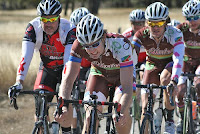 And this is harder than one might expect. Though sunny, it's cold and windy, and the juniper trees are releasing clouds of chalk-like pollen that coat the tongue (extra calories, or bodily invasion?) and inspire sporadic fits of sneezing. Some parts of the route are very narrow and winding, and when teams catch or pass one another, fast-moving packs of jumbled kits form, a giant amoeba tightening and expanding like an accordion. At the back of such a group, two intrepid ATCers meet their match at a low-water crossing. (Three-time IM champion Amy, seeing the carnage in front of her, wisely walks her bike across the raging trickle.) The pack pauses briefly to survey the damage, and finding that no limbs or bodily organs are lost, moves on. To the friendly fellow who said, "Ah, it's the triathletes": Where's the love? Are you jealous of our superior bike-handling skills and aerodynamics? Keep up the mockery and we'll request that next year's route include a 2.4-mile swim.

