Austin Tri-Cyclist Blog

Showing posts with label ATC Racing. Show all posts

Saturday, March 12, 2016

Electronic Shifting FAQ

Service Captain, Chris Warren, admiring new SRAM eTAP

Frequently Asked Questions about Electronic Shifting


By now you've probably heard of Shimano's Di2 and SRAM's new eTAP Wireless groupsets. Below is a collection of questions we've been asked. Feel free to let us know if you have more!

  1. Woah! Is that even reliable?
  2. Why would I want electronic shifting? 
  3. Does it need regular service? 
  4. Can I service it myself? 
  5. How long does the battery last?
  6. How long does it take to recharge the battery?
  7. How many recharge cycles can the battery take?
  8. Are the components light?


Woah! Is that even reliable?

     Yes! Shimano Di2 has been available since 2009. It has been thoroughly vetted on the professional and recreational level. SRAM Red eTAP components were tested in secret for years before they were spotted in the pro peloton and have received widespread praise since their recent public release.

Cervelo P5 with 9070 Di2


Why would I want electronic shifting?

     Because you can!
     But seriously, in both Shimano and SRAM the shift quality is superior to the shift quality of the mechanical groups. The elimination of traditional shift cables means no more derailleur adjustments for cable stretch. It means no more frayed cables. It means no need for barrel adjusters. It means no rusty shift cables. In fact, the electronic components are safe in sweaty conditions and rainy days too. The components are also very aerodynamic, in part, because of the wiring (or lack there of).
     Probably one of the biggest reasons to lust after electronic shifting is the ability to add accessory shifters. Everyone knows that mechanical shifting can only have one shifter per derailleur, but with electronic shifting the signal can be sent from multiple points. Triathletes can now shift from the aero bars, or the basebar. Roadies can shift from the hood position or a “sprint” position. If you fall somewhere in between a tri-geek and a roadie – you can have road style shift levers and shifters on a pair of clip-on aero bars!

Does it need regular service?

     Electronic shifting doesn’t require the same type of service, but it will still need occasional check overs. There are still physical derailleur limits that need to be set and derailleur hangers to be straightened, but most people will find that their semi-annual tune ups will be sufficient. Periodically, the manufacturers release firmware updates to fix bugs and improve things like battery life.

Shimano Di2 Charger/Update Interface

Can I service it myself?

     Sure! The set-up is relatively simple for those that have some mechanical inclination. While the actual processes are outside the scope of this post, stop by and see one of our expert mechanics for assistance.
SRAM eTAP Firmware Update Dongle

How long does the battery last?

      The Shimano di2 battery will last on average 3-4 months depending on the number of shifts. Some riders have reported as long as 12 months on one charge and upwards of 4000 miles. The A Junction box also functions as a battery indicator and will give an indication in 25% increments plus a critical level.
      The SRAM eTap derailleur batteries (each derailleur has it’s own battery) last for approximately 600 miles or 2-3 weeks. This is also dependent on how often you shift. Since the shifters are wireless, they also have their own batteries. These batteries are CR2032s, so they aren’t rechargeable but are expected to last two years.

But I’m still worried, what happens when the batteries die?

      On the Shimano system the as the battery drops to around the 10% level the front derailleur functions stops first. Your last shift will allow you to drop to the small ring. This leaves you the rear derailleur function. This will operate until the battery runs out of juice, and you’ll be stuck in your final gear combination.  We recommend charging the battery when you see the flashing red on the battery level indicator (around 10%).
      On the SRAM system, you’re rear derailleur battery will fail first, because you use it more often. Lights on the derailleurs will let you know as you reach approximately 25% remaining. SRAM is rumored to be working on a battery indicator screen/data field for your Garmin. When the rear derailleur battery runs out of juice, you can swap the front and the rear derailleur batteries and be back in action. In fact, you could potentially swap back and forth several times to efficiently climb hills on the way home. The batteries are also small and light enough to carry an extra in a saddle bag.

SRAM eTAP Battery and Rear Derailleur


How long does it take to recharge the battery?

      The Shimano Di2 battery takes 1.5 hours to recharge. The seatpost battery requires a charger that plugs into the A Junction. The external battery requires a separate charger that the battery plugs into.
      The Sram eTap batteries recharge in 45 minutes each. They require a standalone charger (included in the upgrade kit).

How many recharge cycles can the battery take?

 
     The Shimano battery can be recharged 300 times at 100% integrity. This practically means you’ll never have to replace the battery, because after 300 recharge cycles you’ll be ready for a new bike!
     SRAM batteries are rated at 100 recharge cycles. So, the batteries won’t last as long as the Shimano batteries, but they will last a long time. When you need a new battery, a replacement is available for $40.

Are the components light?

      Of course!! While Sram Red mechanical is the lightest full groupset out there, SRAM eTap is the 2nd lightest configuration available, followed by Shimano 9070 Dura Ace Di2. Ultegra 6870 is the heaviest electronic configuration and also is slightly heavier than it’s mechanical counterpart, Ultegra 6800.

Argonaut with SRAM eTap and Lightweight Wheels, only 14lbs!

Wednesday, January 14, 2015

Sammi's CX Nats Race Report

Sammi Runnels at CX Nationals, DCM Photography

Sammi Runnels offers a unique perspective on the 2015 Cyclocross National Championships. As the only Texas rider in the elite women's race this Monday, she had an advantage: she didn't have to juggle flights or book extra accommodations to compete in the race, which was moved from Sunday to Monday in a now widely publicized debacle involving the Austin Parks & Recreation department, a local tree-preservation organization, and governing body USA Cycling. (If you haven't gotten the full scoop on how spectacularly Austin dropped the ball on CX nats, click here for a thorough report from VeloNews.) Like the other racers and fans impacted by the last-minute changes, Sammi felt angry, and like most of Austin's cycling population, she felt ashamed of the city she calls home.

Compounding the political mysteries that surround Sunday's cancellation is the Lance Question. Did Lance Armstrong, as his Tweet would suggest, favorably influence Austin PARD in deciding to reschedule rather than cancel the race? On social media, some people expressed gratitude. Others found it still more disconcerting that such a controversial figure, banned from the sport of cycling for life, would have a direct line to the powers that be in city government, or they said he was just tooting his own horn about a compromise that had been hard-won by others. Every national and local news source covering the drama seems to be alluding to the Lance Question, but as of yet no reputable source has answered it.

Facebook post from Tristan Uhl, Sammi's boyfriend, who raced with the elite men:
"Are we still cool bro? ‪#‎heritageoaks‬ ‪#‎cxnats‬ ‪#‎cyclocross‬ ‪#‎treelove‬"
On a positive note, the cycling community in Austin and beyond did their best to help racers mitigate the expenses and headaches of extending their stay.

"Although the last-minute schedule change placed a huge scheduling and financial burden on the majority of affected racers, it was touching to see the huge amount of outreach and support for these riders by the cyclocross community," says Jessica Cutler, a Seattle-based pro racing for Jamis Bikes. "Austin residents offered to open their homes to riders along with transport to the airport; people outside of Austin fundraised to help riders defray some of the costs they had to incur; and even professional rider Tim Johnson reached out by sponsoring a free dinner on Sunday night for junior and U23 riders."

Southwest Airlines, whose headquarters are in Dallas, was reportedly waiving fees in the mad scramble to change flights out of town.

Only in her second season of racing cyclocross, Sammi Runnels is just getting started in the sport, but she's one of those people you can say, without a doubt, truly loves cycling. She works full time as a bike messenger (we featured her in a post on commuting tips on Jan. 2), and still summons up the energy to train and race in her free time for both the road and cross seasons. She finished 36th among the field of 46 elite women who started on Monday. Read on for her quick recap of the race.

Sammi's race report: 

Lining up this Monday with pros Katie Compton and Ellen Noble seemed like a dream. Mostly because of the Parks' Department shut down of the previous day. I seriously shed tears listening to behind the barriers hosts telling us there would be no race. I had gone out of state to UCI races to qualify for this race and suddenly it's just shut down? My heart goes out to those athletes who could not make it to the race because of the change. I'd like to thank Lance? Ha. And everyone from USA Cycling for not taking no for an answer. I can only imagine what it took to make them step down. I think I speak for most Texas cyclists when I say I'm embarrassed for my city.

I was so honored to be able to line up and race with these girls. I lined up in the second-to-last row. The call up is based on your UCI points. At the start, I moved up pretty decently on the left side. As in the elite men's and junior boys' race, there was a crash at the start of the hill on the pavement. Our crash was smaller but heavily affected racers like Emily Kachorek, who flatted immediately and had to run to the pit. Luckily I avoided that. The first lap was filled with small slide outs by me and others around me. Luckily we've had a couple of mud races this year in Texas, but I definitely need more practice in the slippery mess. Running up those stairs was definitely the hardest part of the course. The fact that they weren't evenly spaced and were mismatched heights made them especially treacherous. I really enjoyed the mudslide descent before the barriers, though I did slide out pretty hard there one lap.

I had a great time representing my city and state in the U.S. national championship. It was great having so many of my friends out there screaming at me. I definitely want to continue doing more UCI cross races next year. Cross is coming.

Wednesday, October 1, 2014

Race Report: Women's Cat 3 State Road Race Championships

By Katie Kantzes


Marla Briley, Sammi Runnels, Katie Kantzes, Allison Atkinson, Missy Ruthven
Most of my non-cyclist friends and family don’t realize that cycling is a team sport. Typically, they ask if the course was timed, as though it were about personal bests.  Strategic terms like “attacking,” “counter-attacking,” and “bridging” are lost on them. However, if there was one race that could illustrate just what teamwork can do in cycling, it’s this year’s cat 3 state championship road race in Fort Hood.

When we toed the line at 1:10 that afternoon, ATC had four ladies ready to work. Also lined up were Alexis Hamilton (Colavita) and Kelly Barrientes (Think Finance), both of whom are phenomenal racers and who we knew would be our major competition. Alexis and Kelly both have outstanding sprints— so as a team, our plan was to make sure that the race didn’t boil down to a pack sprint. We had to make it hard early and make the other girls chase us for 66 miles in hopes of creating a break.

We went through the first three miles of downhill a bit antsy. I noticed one girl was having trouble clipping in and was swerving a bit, and told my teammate Lori to be wary and pass the word along. Shortly afterwards, around four miles in, Marla threw out a massive attack. It was perfect! Kelly took the bait and went with her, and quickly they became a small speck up the road. We expected the other girls to start chasing (clearly, we weren’t going to go after Marla), but the pack was confused and unwilling to work together.

As the miles went on and the gap increased to over two minutes, a few possible scenarios surfaced. We could let Marla and Kelly go and let them duke it out at the finish. We could continue to bait Colavita and hope that they would get nervous about the gap before we did and start to chase. Or, we could attack the remaining peloton to form another break. Missy, Lori, and I chose the final option. If we could bridge up to Marla without the rest of the field, we’d have all four of us on the podium.

I attacked with 10 miles to go to the feed zone on the first lap and got away for around six miles (thinking “HELP!!!” and hoping that I’d eventually see Marla and Kelly ahead). Lori tried to block Alexis in, but Alexis and Lacy Thomas (FRESH Racing) worked to chase me down about three miles from the feed zone. Lucky for me, Missy had caught on to them without the rest of the peloton.

Our little group pedaled steadily through the feed zone, polite as ever. Our other team members were supporting us with expert bottle handups (thanks Kat, Jack, Kent, Robert!). Soon after, we caught up to Kelly and Marla, who looked pretty cooked. Marla was cramping, and I believe Kelly was too; they soon fell off of the break. Marla had worked to wear Kelly out for an entire 33-mile lap by herself.

Everything looked good at this point—we had a four-person break, with two ATC riders and minus one of our main rivals. Missy and I managed to talk and decided that she would work on the front to keep the pace up until the final, massive hill 12 miles from the finish, where I’d try to start wearing the others down with repeated attacks.

Missy continued working hard, and we rolled through the hilly course at a fast clip until 12 miles to go. Alexis started leading cautiously up the giant KOM hill, with Missy, Lacy, and I following. About halfway up, I swung wide and gave it everything to gap the other girls. I got lucky, and no one was on my wheel. The rest of the race was simple—hold on and hammer for dear life.

I’ve never been so happy and proud to cross a finish line. Our plan had worked perfectly! We communicated clearly, and each of us used our individual talents to contribute to an incredible result. Missy took fourth, time trialing in, with Alexis second and Lacy third. Races like these make me sad that the season is over, but it bodes well for an exciting season in 2015!

Cat 3 Podium: 1st Katie Kantzes, 2nd Alexis Hamilton, 3rd Lacy Thomas, 4th Missy Ruthven, 5th Melissa Monosoff


Cat 1/2 State Championship-Eligible Podium (Lauren Stephens, UCI pro, takes first in the race) :
1st Mandy Heintz, 2nd Meredith Bunkers, 3rd Sammi Runnels

Tuesday, September 23, 2014

2014 Coleman Chevrolet Stage Race Report, Women's Open


The Coleman Chevrolet Stage Race, put on by Edge City Cycling near Texarkana—right on the border of, you guessed it, Texas and Arkansas—is far from home and late in the season, but this stage race is well worth the drive, especially for the women. The women's open payout (when the field size meets the minimum) matches that of the P12 men! Our ATC correspondents reported having unseasonably cool weather and a great time. Read on for a play-by-play of the three-day event from ATC Racing's Allison Atkinson.   

By Allison Atkinson

Katie Kantzes & Allison Atkinson pre-TT
Katie Kantzes and I were not sure if driving five hours up to Texarkana for a stage race would be worth it, especially with only 10 signed up in the women's field, four of which were from Dallas Racing. Well, the drive up actually took us eight hours, and we still aren't sure why. Even with the longer drive, we decided that WE would make the race worthwhile and showcase a little of what makes ATC Racing special. In short, we would bring the party AND the pain to Texarkana! And yes, it was totally worth it!

Road Race 1
Day one (60 mile road race) was cold (in the 60s) and drizzly. I could not believe that I was racing in arm warmers and truly felt like I could catch cold out there. Lap one was an awkward dance. Smaller field sizes resulted in combining the women 3/4's, Women Open, and Men 60+. The men took responsibility early on, setting a great tempo. The men also, however, greatly changed the dynamic of the first 30 miles. One of them would get into a break with the women, which caused a chain reaction of competitive men chasing, pulling the group up to the break. Who knows if the breaks (all of which Katie or myself were in) would've stuck had a man not been in the mix? Our Women's Open group awkwardly let the Women 3/4's and men (who only raced one lap) go ahead and sprint to finish.

We continued at a steady pace starting lap two. We ate and talked, which made me nervous. I don't like making small talk in general, much less mid-race. I became annoyed but kept my guard up while trying to eat and drink. Attacks would certainly come from Dallas Racing and the two Team Primal Racing riders from Denver. Andrea Thomas (Dallas Racing) attacked on the first sizable hill. Katie and I looked at each other. I spit out whatever I was eating and yelled "We gotta go NOW!" We took off, and I used my momentum to pull for a while on the flat. Andrea was in sight. Getting out of the saddle on the next hill, I kept the chase pace strong till Katie came around and up the hill to Andrea.

Solymar Rivera (Dallas Racing) countered, and we chased. This continued till confusion set in on a mismarked turn. I happened to drift to the back of the pack approaching the turn because I thought the sign (pointing straight) was supposed to point right. All the women went straight except for Andrea, who took the right turn hot and then attacked. I scanned the road ahead and saw everyone turning around. I decided to chase Andrea, who was already up the road quite a ways. I bridged and worked with Andrea for about five miles before we were caught. It was the efforts of the Team Primal Racing women that shut it down.

Team Primal Racing kept the pressure on in the final 10 miles with attack after attack, but nothing stood a chance of staying away without a Dallas or ATC lady in the mix. Solymar tried to get away early leading up the finish. Katie and I didn't let that happen. Approaching the base of the uphill sprint Andrea attacked early, launching Solymar, Katie, and me into a first, second, and third place finish.

Time Trial
The TT was just under five miles of rollers. Katie looked a like a fish out of water warming up on her borrowed TT bike. It was the first time she'd ridden a TT bike in her life, but, as our team's supporters suspected, it was better to force her to race it knowing she has the makings of a great time trialist (even though she was a little sketch). Our suspicions were correct! She placed second!

Andrea was first, and I was, again, third. GC was greatly affected by the TT because Solymar finished lower than expected. Now we would really have to watch Andrea, who was first in GC by a slim margin. I still had to watch Solymar because she could try and get into a break to get time on me for third GC.
Katie Kantzes on a TT bike! See more race photos at www.robertspangle.com/

Road Race 2
Day two (50 mile road race) felt just as cold in the morning but quickly warmed up to the 80s when the sun came out. Our goal was to get on the podium and win the Team competition, which we were already leading. We were combined again with the same faces, and this time the men raced the full distance with us.

Team Primal Racing & ATC Racing
With centerline rules in place it was hard to maneuver around, so I had to be at or toward the front to avoid being boxed in should something get up the road. The men took on a lot of the responsibility, setting a good pace early. Katie and I sat in; nothing really happened till we hit a series of stair-step climbs. I believe a 3/4 woman started trying to ride away, which caused a weird chase because the men (whose wheels I followed) didn't care and sat up.

This led to a jumble of men sitting up in the climbs, 3/4 women blowing up in pursuit, and 1/2 women trying to maintain a  good position. I looked over at Katie, who seemed annoyed or bored or both. There was a pretty long climb ahead, and it was still the first lap for us, but Katie found her way out of the tangled mess and just started climbing at her own pace. It wasn't an attack, just a quicker climbing pace that allowed her to ride away. Andrea saw this and had to work for a few moments to get around some tired climbers, but she managed to bridge up to Katie.

GC podium - Andrea Thomas 1st, Katie Kantzes 2nd, Allison Atkinson 3rd
Solymar and I looked at each other. Our GC leaders just formed a break only 15 miles or so into the race. What now? The two Team Primal riders worked their way to the front, where I sat on their wheels as they fiercely chased. The pair worked well together till we found ourselves on another long climb. One of them rode away, and I stayed with her with Solymar in tow. Solymar attacked, I chased, and the three of us stayed together till we were caught. I knew that I had to watch Solymar. I talked with the Team Primal ladies, who were upset that they had to chase completely alone. They really wanted to break away with me at five miles to go. I refused because I knew Solymar would come with us, and I didn't want to stir things up too early. I asked if they'd help me keep the pace fast at 1k to go to string things out. Eager to help, they did just that after rotating with me at a mile or so to go. I finished fourth, Solymar was third, and Andrea pulled off first with Katie second. Overall we were pleased with the day's efforts and happy that we'd reached our goals.

I felt like the small field made for a harder race. I honestly hadn't had the opportunity to race that hard or feel THAT tired in a while. Katie and I got a good feel for how to work together and discovered we make a great team! The courses (especially day two) were hillier than expected. It was a great weekend, and the best part was I GOT TO WEAR MY OFFICIAL SLURPEE HAT ON THE PODIUM! I will definitely race next year and hope to see bigger fields then—ATC will bring the party and pain again to the women's field!

Tuesday, June 10, 2014

2014 Texas State Time Trial Champion
Gear and Tech Specs

by Jack Mott


Being former or current multi-sport athletes in many cases, the ATC Racing women pride themselves on their time trialing prowess and put up impressive results at this year's Texas State Time Trial Championship. Katie Kantzes nailed a third place in the Eddy Merckx category, Marla Briley got second in category 3, and Kat Hunter took first place in Cat 1/2. (You can read Kat's race report on TexasBikeRacing.com.)

On Sunday, the team of Missy Ruthven (ATC owner), Maggi Finley, Marla Briley, and Kat Hunter backed up those impressive results with a 56:37, fastest women's time, in the team time trial.

To give you an idea of the attention to detail that goes into a winning time trial, we will break down all the gear, aero data, and power data of Kat Hunter's winning ride.


Bike Build Specs
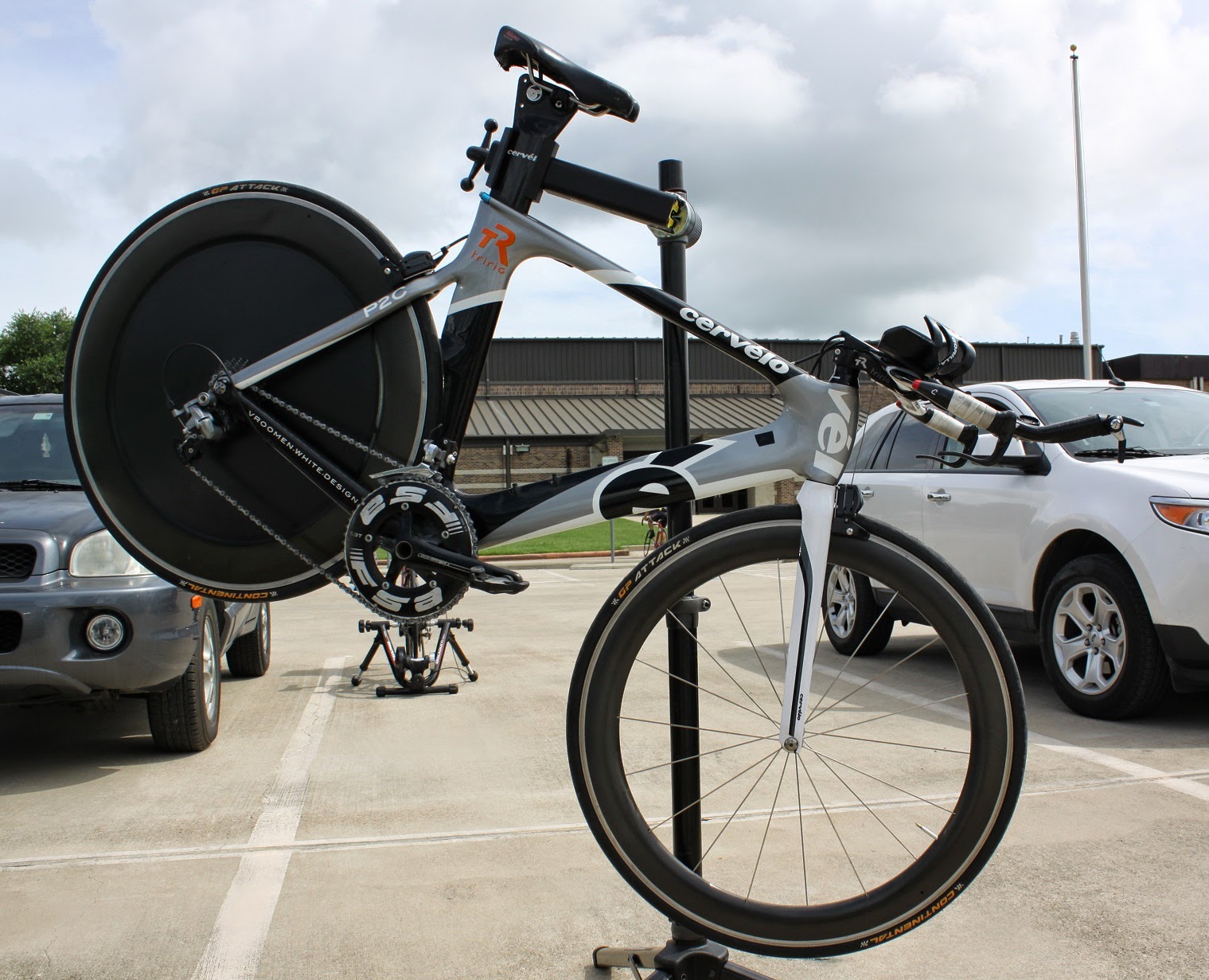
  • Frame - Cervelo P2C classic with modified top tube cable routing 
  • Wheels - HED Jet 6 front, HED Jet 9 with wheelbuilder disc cover and G3 Powertap hub
  • Tires - Continental Attack Clinchers, 22mm @ 105psi with Vittoria latex tubes
  • Aerobars - UCI Legal HED Corsair with integrated brake levers and Vision clipons
  • Stem - TriRig Sigma aero stem
  • Fork - Cervelo FK26
  • Brakes - TriRig Omega aero brake
  • Saddle - Adamo
  • Head Unit - Powertap Joule
  • Hydration - One between the arms rocket science bottle in a XLAB Gorilla cage
  • Skewers - View-Speed aero bolt on skewers
  • Helmet - Giro Selector
  • Cranks - FSA Gossamer with FSA 54T aero chainring
  • Pedals - Look Keo Blade aero pedal
  • Gruppo - Shimano Ultegra
  • Cassette - Shimano Dura Ace 12-25
  • Derailleur Pulleys - Hawk Racing
  • Bottom Bracket - Hawk Racing
  • Chain Lube - Rock n' Roll Extreme
  • Bar Tape - Tennis grip from Target. I dunno. It was thin.
Power Meter Data
  • Goal Power -  250 watts
  • Actual Average Power - 247 watts
  • Variability Index - 1.0
  • First Half Power (Headwind) - 254 watts
  • Second Half Power (Tailwind) - 241watts
  • Avg Temp - 82 deg G
  • Avg Cadence - 92
  • Avg Speed - 26.6 mph
  • Distance - 40k
  • Time - 56:23

Power File


WKO+ Power File from the TT

Aero Data

Approximate yaw angle distribution from BestBikeSplit.com


Using BestBikeSplit, an excellent online aerodynamic and pacing tool, we can approximate that Kat had a CdA of approximately .20 at 0 yaw, and .19 at yaw. We can also see that about 70% of the race was between 0 and 5 degrees of yaw, with most of the rest of the race between 10 and 15 degrees of yaw.  Knowing what the angle of attack of the wind is during a race can help you make intelligent equipment choices. For instance, we can see from this data that a deeper front wheel would have been faster, as around 30% of the race had yaw angles where a Jet 9 is a bit faster than a Jet 6.  Since about 70% of the race was at very low yaw angles,  choosing a narrower tire was definitely a good call. Narrow tends to be aero, at low yaw.

Close-up Bike Shots 

The venerable P2 Classic remains competitive

View Speed Skewers, Cervelo FK26 fork, and HED Jet 6 with Continental Attacks

HED Jet 9 with a disc cover taped on,  nice clean chain

TriRig brake, stem, and HED aerobars make for a clean front end


Thursday, May 22, 2014

The Women of Bike Racing
ATC Racing’s Marla Briley & Katie Kantzes

Continuing our effort to put women’s racing in the spotlight, ATC Racing members Marla Briley and Katie Kantzes write about how they found their way into the sport and what it means to be competitive cyclists.
Marla making a solo attack at the Driveway.

Marla, co-captain of ATC Racing and long-time triathlete, is one of the founding members of the team. She and her boyfriend, Kent Snead, are the team’s biggest behind-the-scenes supporters, both in terms of sponsorship dollars and devotion to day-to-day operations. Marla and Kent sponsor the team in the name of GSP Rescue, the German shorthaired pointer dog rescue organization that Marla helps run as president (alongside her full-time data-wrangling job!). As a teammate, Marla is pure gold, always willing to use her talent on the bike to selflessly and aggressively work for the team win. She’s now back to biking, running, and racing at the Driveway Series after ACL surgery in November 2013.

Katie, who’s working on her masters at the University of Texas in public health epidemiology, is the newest member of the team, joining at the beginning of 2014. A mean hill climber, she’s a veritable aristocrat of the local Strava scene, with 273 QOMs to her name.  Those who don’t Strava will probably know her as the girl who doggedly hangs on to the hardest Austin group rides, often with a smile on her face.

Marla and Katie were willing to share photos from their earliest days in cycling. Pictured below on their first bikes, they would have many, many more miles of riding in their future.

From Marla Briley
Everyone has heard of the “Butterfly Effect,” or maybe you saw the movie? In chaos theory, the butterfly effect is the sensitive dependency on initial conditions in which a small change at one place in a deterministic nonlinear system can result in large differences in a later state.- Edward Lorenz
Marla at Captex in 2004, her first triathlon

I experienced something very similar but like to call it the “bike effect.”

In 2000, I went to work for Bike.com. I knew nothing about bikes and came to the job through the IT department. I met a few of the guys in the back. These cyclists turned phone support were the “real” bike guys and actually had intelligent conversations with prospective customers. I conducted Q&A on our site to make sure it wouldn’t crash if someone actually visited. I thought it would be a good idea to buy a bike; I mean, I got the bike at cost, and would maybe, through owning a bike, better understand the jargon and lingo everyone was talking. Of course the only brands we carried were Giant and Schwinn. I decided on a Giant. The guys in the back helped me pick out one that would fit me and my budget. When it arrived, they made sure to remove all reflectors (they could not have me looking like a Fred) and outfit it with clip-in pedals (which I had no idea how to use). One of my first rides, a 20-mile jaunt through the Austin neighborhoods with one of the “real” bike guys, left me so tired and dehydrated (I had not learned how to ride and drink at the same time) that I cramped up and fell over at a stoplight.

That is how I came to the bike. What amazes me is how the bike has shaped my life. In 2001, a friend convinced me to join a Team In Training group. We raised money and awareness for leukemia while training for a 100-mile bike ride around Tahoe. During that adventure I met one of my longest running friends who helped me get an awesome job at the company where I still work. Also, I made a friend, who became a training partner, who later became my much better half.

After Bike.com went the way of most dot-coms, I decided the only way for me to keep the bike out of mothballs was to have a goal. I had always enjoyed running and had even swum on the JV team in high school, so why not triathlon! I joined a local training group, and they helped me prepare for my first 70.3. From there I went on to complete multiple half and full Ironman races. These races and adventures have brought me the best memories and experiences of my life.

In 2011, I was invited to join an all-women’s cycling team. I have learned so much about myself through road racing and being a part of ATC Racing. I have learned how much I enjoy racing on a team and not just for myself. I have realized I like to be in control of my surroundings, and I need to be okay with it when I’m not. I have also found out that I’m not as tough as I thought I was, but I’m braver than I give myself credit for. With the help of my amazing teammates and my coach Gray Skinner, I am continuing to grow as an athlete and, hopefully, become the best cyclist and teammate that I can.

Between racing and training, cycling is a huge part of my life. It shapes most of my week. There are the everyday training rides and every Thursday, from spring till fall, the chance to race my bike at the Driveway. My boyfriend and I spend many quality hours riding our bikes together. We even plan our holidays around new places we can travel to ride our bikes.

All these things I have learned, all of these amazing people I have met, the friendships I have gained, and where I am today—it’s all because I bought a bike.

From Katie Kantzes
When questioned about my farmer’s tan, or asked what I do for a hobby outside of school, my standard answer is “I ride bikes.” With the puzzled look that typically follows I add, “You know. In spandex, like Lance Armstrong.”
Katie on one of her first training rides in 2012.

I mean, I wish I rode that fast. But even if I was slow as hell, I’d still ride. The draw of bike riding and racing is less explained and more easily experienced: it’s something that develops over time, as many things of value. It certainly took time for me. Even though it seems like a straightforward sport (you just ride in a straight line and try to not crash, right?), I’ve found that I learn more and love the sport more on every ride.

I first got on a bike three and a half years ago – if you count the spin bike in my then-boyfriend’s gym. I had just sprained my ankle after my first half-marathon. Prior to that sprain, I’d had every injury in the book: chronic overuse in both calves, patellar tendonitis, pulled hamstrings. But the bike was fun. It was easy to go hard and not get injured. So I hammered away, indoors, for a year or so.

When I braved the paved road I fell over at every stoplight because I couldn’t unclip. Once I could clip in, I got dropped on every ride. I told myself so long as I can see the group up the road I’m fine! But as I tacked on the miles, I got better. I learned to love hills and long endurance rides, and then last year I learned what it was like to do those long miles with the encouragement and unpredictability of a pack. As the basics (pedaling, drafting) became natural habits for me, I began learning how to read the pack, how to attack, and how to push my pain threshold.

There are several things that attract me to racing: the nervous tick when lining up, the thrill of attacking, and the beautiful exhaustion that comes from an effort that was previously beyond you. The most rewarding aspect of riding for me has been the friends I’ve made on the road. I have never been so consistently surprised at the openness, companionship, and generosity of an entire community as I have been with cycling. The community is what keeps me riding more than anything else, and I’d encourage anyone with an inkling of interest to give it a shot.

Friday, March 28, 2014

For New Women Bike Racers:
Get Started, Get Connected


Bike racing is an intimidating sport. There’s the equipment, the pack riding, the race tactics, the daily mileage. For a beginner starting from scratch, the prospect can be even more daunting. What kind of wheels or tires should you run? What group rides should you try? Where can you register for races? How do category upgrades work? When should you think about joining a team? And then there are the simple questions that you’re almost too embarrassed to ask. What should you wear? How do you pin a number on? What’s a “rookie mark”? 

We need more women racers in the peloton! If you’re interested and looking for a way into the sport, let us help you make the transition. This year ATC Racing has created the Women’s Racing Foundation of Austin, a nonprofit focused on promoting and growing women’s racing in the local community and beyond. Composed of seven competitive riders, our team ranges in age from 22 to 53 and in occupation from bike messengers and chefs to small-business owners and nurses. All of us are relatively new racers, so we know what it’s like to be the new girl. No question is too silly.

The way it works: We’ll pair you up with an individual rider on the team. You can chat via email or phone, meet up for rides and races, or just have that person available to answer questions when needed. We’ll help you get acquainted with other riders and teams, too. (ATC Racing is not taking on new members at this time.)


Email us at contact@atcracing.org to get connected with us and learn more. You can also check us out at our team website, ATCRacing.org, and on Twitter. Happy riding!  

Thursday, February 27, 2014

Walburg Classic Race Report, February 22, 2014
Cat 5A race

by Kimble West, ATC 360 employee

Going into Walburg, I had been told the race would suit me well, which was the reason I got excited to do the race on Saturday. I had been warned by some veterans that Walburg is always a windy, poor weather race. The weather turned out alright temperature-wise, though the wind picked up and made for some excitement.
 
I woke up early Saturday morning to make sure I had time to pack everything I thought I might need into the car. With the way our weather had been, I packed some extra cold weather gear (which I was sure glad to have during my warmup). My teammate Chris and I got all of our gear and bikes loaded, and we headed out to Walburg. On our way to the race, we tried to keep each other relaxed by joking around and making fun of each other. Walburg was Chris's first road race and my first one of the season. As we made the turn off the highway towards Walburg, we struck a deal that we would yell at each other if one of us was doing too much work at the front. We were worried that we would waste all of our energy at the front and get dropped.

After getting registered, Chris and I warmed up.  We were told by a Cat 2 that a few breaks would go off the front, but the pack would reel them back in before the finish and not to worry about any breaks. We decided that he was probably right and that if anything we would just take a couple of pulls at the front to help the chase pull anything back in.

We did our last-minute checks and headed for the start line. Chris and I lined up at the back (we were a little late) with the 46 other Cat 5As. We lucked out, though; the race started out neutral, which gave us plenty of time to settle in and scope out a way to the front. Our race almost ended prematurely with a crash that happened right in front of us. The crash only involved one rider, and everyone else managed to escape unharmed, but it did make Chris and me give each other a bit of an uneasy laugh.

The race finally started. I looked back at Chris to make sure he was following me as I began moving up through the field. There was a nice tailwind in the first part of the race that kept our speeds pretty high. I could see a couple of guys making moves off the front, but nothing seemed very serious. Once we made it up to the first 15 or so riders, I found a spot to just sit in and keep from putting my nose in the wind, while Chris kept slowly making his way forward.

Somewhere around mile 7 or 8, a United Healthcare rider made a move and got away, and then a Jack & Adams rider chased after him. They started to work together and seemed to be making a decent gap on us. Chris moved up to the front and took a pull, but as he pulled off we slowed back down, and the break started to make more ground on us.

At about 11 miles into the 28 mile race, I realized I couldn't let a Jack & Adams rider beat Austin Tri Cyclist, so I moved up through the other riders thinking I would jump on the front and help reel those guys back in before they got away too far. I got on the front of the group to take a pull, but everyone around me slowed down. I was feeling really good and wanted to test my legs, so I made a move to bridge the gap.

As I started making my move, I knew I had promised my teammate that I wouldn't work too hard, but I just felt too good to worry about that. I bridged the gap quickly, but it had taken a lot out of me, and I started to think about how the move I had just made was stupid and I had just wasted a bunch of energy.  The other two riders in the break started to form up, and we began our pace line.  I was recovering quickly, but I knew I would need to conserve my energy in case we got picked back up by the pack. We made the right-hand turn into the wind, and we quickly found a rhythm in our pace line and kept trucking along in front of the group. As we drove along, the only thing that was going through my head was what our Cat 2 friend told us before the race: don't worry about any breaks because they won’t last.

Then around 15 miles in, we had another rider join our break, making four of us. He got our pace back up and got all of us to start working harder. We kept up this pace for a while and seemed to be making really good time, but it didn't last. We made a turn and started up a climb. The hill seemed to be deceptively steep and difficult. When we hit the climb, Mr. J&A kept up the pace, and I jumped on his wheel when I noticed the other two riders start to fall back. After cresting the climb, I pulled through and glanced back. Our other comrades had fallen off pretty hard and seemed like they were sitting up to wait for the chase group. So Mr. J&A and I regrouped and started to push the pace. I looked down at my computer and saw that we still had about 10 miles left to go. I was worried that we would get picked up before we made it to the finish, so I tried my best to conserve my energy for the field sprint I was convinced was going to happen. I thought my chances for winning the sprint were good even if it was a large field sprint, but I didn't know for sure after spending so much time in the break.

We kept our pace high, and Mr. J&A pulled me up the hills, and I took us down the rollers. We kept this rhythm for another 7 miles before I looked down and noticed we only had 3 miles to go. I risked taking a look behind us to see if we would make it, and I saw the chase group was starting to breathe down on us, but ahead was a twisty section that would play to our advantage. I took the lead and railed through the corners, and we started to open our gap back up.

We kept that pace all the way through to the last right-hand corner, which revealed a couple of flags on a short hill in front of us. Mr. J&A and I slowed our pace to a crawl, to see what the other would do. We asked each other if this was the finish as we climbed up the little kicker. Once at the top we saw the 200-meter marker and the finish line. We had already started our cat and mouse games and had no plans to stop playing. I was able to fall back behind him and let him lead me out to the 200-meter marker and made my jump and sprinted for the line. I was too wrapped up in the moment to know whether he got onto my wheel so I pushed harder and lunged for the line, taking first. Afterwards I was slightly confused, then overjoyed when I realized I had won first place, and I threw up an arm in excitement.

Saturday at Walburg was my first race win and has me excited for this coming weekend at Lago Vista to try and go for it again. Even Chris admitted to having fun and is excited to try again this weekend. Even though I don't think Lago Vista will be as windy as Walburg, Sunday does have that hard climb and that should make for an interesting race.

Saturday, January 25, 2014

Free Trainer Video from ATC Racing

Click the link below to view a free trainer video from ATC Racing. The workout is approximately 68 minutes, with footage from a team practice and the Wednesday morning Gruppo VOP ride.

http://www.youtube.com/watch?v=vv1rm0zek58&feature=youtu.be

The Team
We have a strong women’s team for 2014, with returning riders Lori Bergeron, Marla Briley, Anne Flanagan, Kat Hunter, Sammi Runnels, and Missy Ruthven, as well as new rider Katie Kantzes. Check out our team website, atcracing.org, for rider info, photos, 2013 race reports, and more.  

The Thought Behind It
This is an amateur video, comprised entirely of GoPro footage, and represents the first time we’ve ever touched video editing software. We welcome (constructive!) criticism. Please email us with comments at contact@atcracing.org. We hope to create additional trainer videos that put women’s racing in the spotlight, using footage from local races and our favorite Austin group rides.

Music  
The original video was paired with music, but to avoid copyright issues, you’ll have to use your own music or download the songs yourself. Check out the suggested playlist, which corresponds exactly with the footage, at http://atcracing.org/news.html. Download the songs from Itunes or Amazon, create a playlist in the same order, start playing the playlist at the same time as the video on your computer or your headphones, and voila!

Wednesday, September 25, 2013

New Bike, New Start

by Kat Hunter
The Boardman AiR 9.2S

When the Boardman line came to ATC in April, we posted the review Boardman Bikes: A British Powerhouse Arrives in Texas. My husband, Jack Mott, was its author and guinea pig, field testing the AiR 9.2S at the Veloway side by side against his Cervelo S5. Pregnant at the time, I hadn’t gotten a chance to ride the Boardman bike, but I knew that the frames had become popular over the summer. When ATC said they wanted to put me on an AiR 9.2S, I jumped at the opportunity.

Boardman Bikes may be new to the States, but the company has plenty of street cred. Named for cycling legend Chris Boardman, who is also director of the company’s R&D department, Boardman Bikes sponsors a host of uber-talented athletes. The Brownlee brothers, British ITU triathletes, took Olympic gold and bronze on the AiR 9.8S.

The shape and weight of Boardman’s AiR frames are the same, with models differing in price and paint job according to their gruppo. The AiR 9.2S, the median option with Ultegra Di2, has personality. Matte black with yellow and white accents, she’s a mean girl. Internal electric cable routing and a carbon fiber frame make her sleek and light, and from fork to seat post, she’s wind-tunnel tested and aero. The brand lettering on the flat, airfoil down tube is prominent without being cartoonish. My favorite subtle detail: the inside of the fork and seat stays are a bright, solid yellow, a design element that seems mildly racy, as if the AiR 9.2S is sporting red garters beneath an otherwise staid business suit. Online specs say that she comes in at 17.1 pounds with training wheels.

I fell in love on the first ride.

Cinderella
In early August, I was in a slump. My return to bike racing post-baby had gotten off to a discouraging start. Progress was slow, and then a little over a month into training, I’d had a crash that took me off the bike for two weeks. I felt like a much larger and slower shadow of the bike racer I had been before my son was born, and I feared I’d never make a full comeback.

The Boardman bike was a good kick in the pants. I’m no Alistair Brownlee, but I’m a decent Cat 1. The bike rekindled the competitive spirit in my heart and legs, despite their diminished state. From that first ride on, I felt like I was back on track; I would be fast again...or no, even faster.

Typically, I don’t like change. I tend to hold on to my equipment until it’s dead or dying, but the day I got fit on the Boardman, the new pair of Giro road shoes I’d ordered had come in. I’d also recently replaced the helmet that had cracked in the crash with a shiny new LG Course. I thought of something I’d seen in an IKEA catalogue—a prescription that “even new towels make a big difference.” Maybe I’d started with that idea, but in the end, I’d gutted the whole house.

My nervousness about the top-to-bottom makeover was eased by the fact that I was getting a professional fit. Stefan Rothe of Rothe Training fit me on the Boardman, checking my saddle setback, seat height, reach, and drop to the bars. New bike or no, I knew it was something I needed. Jack and I had changed the setup of my old bike so many times since my last fit that nothing felt quite right anymore, though I couldn’t say which individual thing or combination of things needed to be fixed. With the new fit on the Boardman, I felt less constricted, and I could shift and brake more easily in the drops.

We made some other modifications to match my old setup. I’ve always ridden 170mm cranks, so we put on the FSA SL-K Light compact crankset, and we swapped out the bars for a narrower size. The AiR 9.2S is shipped with very nice training wheels and race tires—the Mavic Ksyrium wheelset with Vittoria Open Corsa CX tires. The saddle, the Fizik Arione Titanium is good, too, but I’ve used the Selle Italia Lady Gel Flow since the start of my pregnancy with zero problems, and I’m not ready to give up my security blanket just yet. Even if it does make weight-conscious roadies cringe.
  
I think of all the reasons to get a fit—saddle sores, back pain, knee pain, comfort, better efficiency—perhaps the most important is peace of mind. The new setup felt good immediately, and, confident in Stefan’s expertise, I knew I wouldn’t want to touch a thing for a long time.

On the inaugural ride back home from ATC, I felt like I’d been given new legs. The Boardman seemed bigger (I think we’d raised the saddle height), yet at the same time noticeably lighter, almost delicate. My new carbon fiber glass slipper.

Apart from the raised saddle, the biggest difference was the Di2. I’d never had electronic shifting before, nor ever imagined I would want it. I preferred having the control, feeling the gears click into place...or so I’d thought. The Di2 was amazing. Click a button and with a soft mechanical rasp it shifts smoothly every time. Several people had told me that with Di2 you could change gears no matter how hard you are pedaling, and while I haven’t found that to be true, I like the fact that I don’t have to worry about dropping my chain.

Even glass slippers don’t fit perfectly right away, though. Roughly a month later, I’m still getting used to the Boardman. Jack loves the science behind the bike, the yaw angles and training graphs and various components. I can appreciate the technical side of things, but for me, a large part of the attraction is a kind of physical escapism. Most days, I just like to feel my legs going around in circles, the harder the better. The newness of the Boardman is nice in its own way, making each training ride exciting, but I also like it when my bike feels like a second skin, when the “old hat” is old enough that I forget I’m wearing it. I think that’s beginning to happen; the Boardman and I are developing a relationship of trust, one where we can go around a corner together at something approaching top speed...though I have a sneaking suspicion she still thinks me unworthy.

Links
AiR 9.2S specs
Previous ATC Boardman Bikes review, Boardman Bikes: A British Powerhouse Arrives in Texas
AiR 9.2S at ATC