When upgrading your
ride, whether you’re buying new components or purchasing a completely new
frame, a good way to start is to decide how much you want to spend. Especially
in Austin, it’s not unusual for an athlete’s bike to be worth more than his or
her car. (Who needs working AC for the workday commute when you can have
integrated aerobars and hydraulic brakes on race day?) But buying a new bike certainly
doesn’t have to break the bank; striking a balance between what you want and
what you can afford, you can build up a ride that leaves no room for
excuses.
Recently, a common
price point for buyers in the market for a new TT bike seems to be $3,000, so
we’ve put together some info on three popular options at ATC that fit the bill:
the Cervelo P2, Boardman Elite Air TT 9.0, and BMC TM02.
Don’t let the
numbering confuse you—the new version of the P2, which was released at the
beginning of 2014, shares the exact same frame as the more expensive P3, with a slightly modified and easier-to-manufacture fork as the only difference. All
components are standard and located in the standard places. There are no hidden brakes or integrated aerobars to make maintenance or travel a hassle. Read our
detailed February 2014 post on the P2 here.
The Boardman has a
different look and color scheme than many other TT bikes—it’s less angular, perhaps a little more aesthetically “classic.” The improved 2014 frame, said to
be even faster than the one Pete Jacobs rode to his Ironman World Championship
win in 2012, is identical to the 9.2 and 9.4, with the only differences
being paint and spec. It features hidden brakes both front and rear. Meredith Kessler rode it to three wins in three races
this season, including the 70.3 U.S. Pro Championships. Read more about
Boardman’s line of bikes and arrival in Texas in our April 2013 post here.
The edgy TM02 is a close relative of Taylor Phinney's TM01, the bike he rode during his U.S. National TT Championship win. It features the same basic frame design as the TM01, including a trick hidden rear brake, but with standard front brake and aerobar arrangement for easy adjustment and maintenance. The BMC is wind tunnel- and race-proven, with a striking look and color scheme.
Can't decide if you want a stylish, boutique European brand, or a cleverly engineered North American bike? Boardman Bikes may solve the dilemma for you. Chris Boardman is an Olympic champion, three-time World Champion, and hour record holder. Those unfamiliar with his history of time trialing prowess and technical acumen both in training and bike design may enjoy this documentary. Unlike other brands that just pay to plaster a former pro's name on the bike, Boardman Bikes actually employs the person it touts on the downtube as the head of the company's Research and Development department.
So what has the Boardman brain trust produced? A line of time trial bikes that won the 2012 Kona Ironman World Championship, an aero road bike that won ITU triathlon gold and bronze at the 2012 London Olympics, a super-light sub 900 gram frame, and a whole line of road, mountain, and cyclocross excellence. Until now there was no way to get these bikes in the U.S. other than mail order. Austin Tri-Cyclist has brought Boardman Bikes to Texas, with models already in stock for you to test ride! We don't have the space to review every model that Boardman offers here, but we will give you a quick look at two of their coolest options:
The Kona Winning Boardman AiR/TT
Boardman AiR/TT/9.8
This is the time trial bike that Pete Jacobs rode to Kona victory last year. It features an overall shape very similar to a Cervelo P2, but with a trick fork that includes an integrated front brake and a hidden rear brake. Additionally, the stack and reach on these frames are lower and longer than the P2 or the new P3 and P5. Athletes who are frustrated with the high stack trend of some of the usual brands should give this frame a look. The AiR/TT comes in a variety of different builds and colors, all sharing the same frame and fork. The frame is CFD and wind tunnel designed, with a BB30 bottom bracket and internal cable routing. If you've been seeking a well-engineered TT bike, but want your ride to stand out from the crowd in the local transition racks, the Boardman is the ideal choice. Check out the video below for a tour of the bike's features from Chris Boardman himself:
The Gold and Bronze Medal Winning Boardman AiR Road Bike
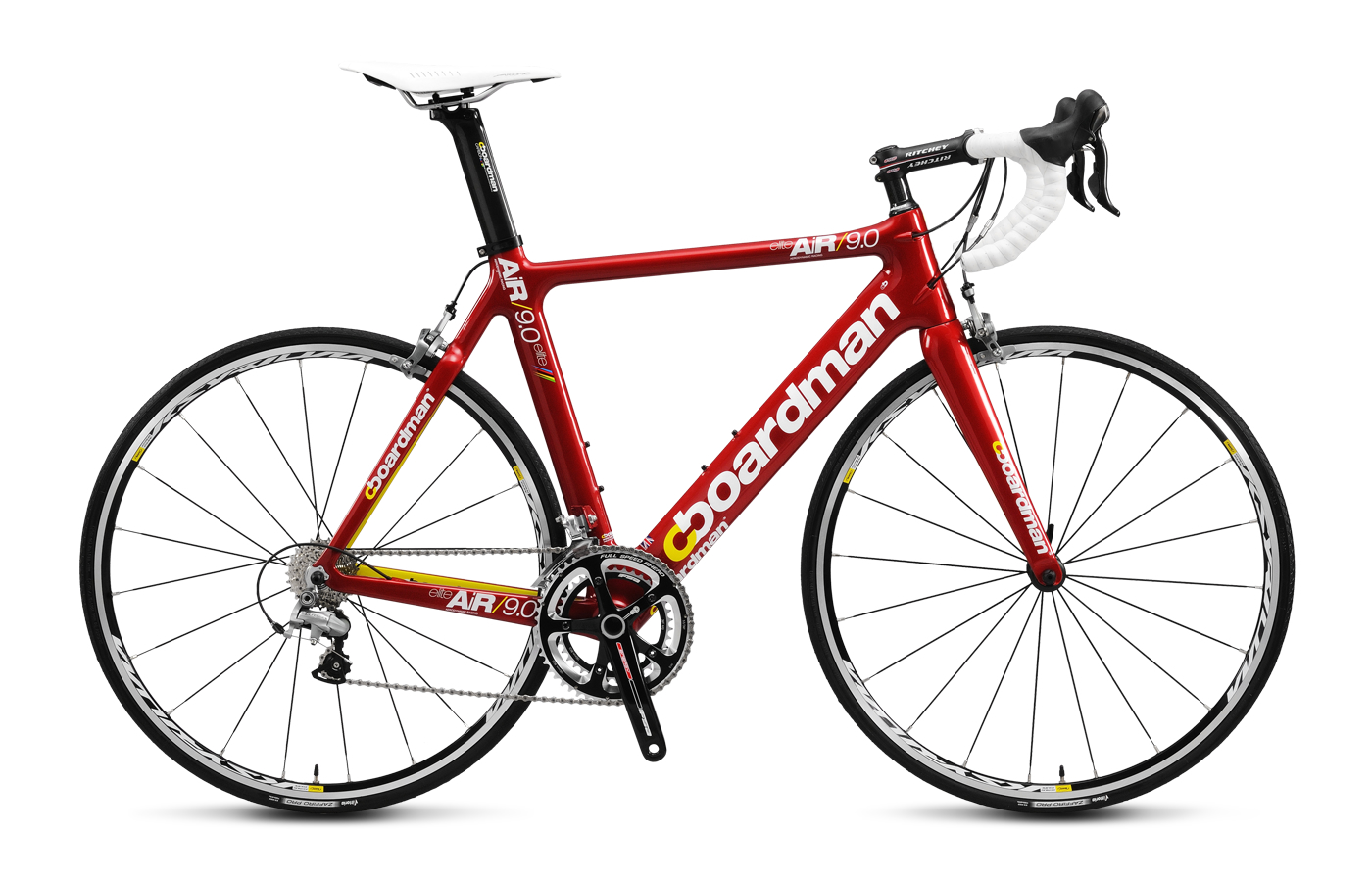
Boardman AiR/9.4
Aero road bikes have been catching on big time, and Boardman's AiR road frames have been proving themselves for years under the Brownlee brothers in draft-legal ITU triathlons. Numerous race wins, ITU world championships, and a gold and bronze medal at the 2012 London Olympics have established the bike's ability to go fast and handle well in a pack of triathletes going full gas. Like the TT frames, these road bikes offer lower, more aggressive geometry than other aero road frames such as the the Cervelo S5. They also build up light enough to weigh in under the UCI-legal limit of 15 pounds, even with aerodynamic wheels. The same design philosophy of the TT frame is applied to the road frame, with the stiff BB30 bottom bracket standard and internal cable routing to shave away aero drag. The road frame uses standard brake mounting for ease of maintenance and wheel changes. Again, many models and colors are offered, and all are based on the same frame, so you don't get shortchanged going with a less expensive model. Chris takes you on another tour:
The AiR 9.2S Field Tested
The Veloway Testing Grounds
I decided to put the aero road bike to the test up against one of the fastest bikes in the world, the Cervelo S5. The testing ground was the Austin Texas Veloway, a 3.2-mile loop featuring short, steep climbs; tight, technical turns; bumpy pavement; and fast, straight descents. The area is also somewhat shielded from the ever-present, gusty winds of Central Texas, which makes comparison easier.
I set the fit coordinates of each bike to be identical – saddle setback, saddle height, and the stack and reach of the bars. I then did a series of laps on the Veloway, alternating from one bike to the other. An important detail is that each run was done on the exact same set of wheels and tires: HED Jet clinchers with Continental GP4000S tires. Since wheels and tires can have a profound effect on speed, handling, and comfort, this is an essential, if annoying, step you must take when test riding or comparing bikes.
The Boardman felt great. I was immediately able to attack the corners just as confidently on the Boardman as I was on my own S5. Comparison with the super-cool Strava website Raceshape confirmed that the bikes were evenly matched around the hairpin turns. Up the steep, short kicker on each lap I would do a 1000-watt surge to get a feel for how the bikes felt at full power, and the Boardman proved to be plenty stiff and stable powering up the hill. The bike showed none of the uncomfortable properties some say they experience on aero road bikes, with everything feeling perfectly composed over the sometimes cracked and bumpy pavement at the Veloway.
GoldenCheetah's Aerolab
Virtual Elevation
A total of 6 laps were performed, a set of 2 with each bike at increasing power levels: the first at 200 watts, the second at 250 watts, and the third at 300 watts. I was careful to hold the same position with my head, body, and hands for each lap, and I wore a skinsuit to reduce the error that loose clothing can introduce. Using a clever method called the Chung Method, also known as Virtual Elevation, you can take power files from these runs and determine an approximation of the aerodynamic drag. Since public wind tunnel data is not available for the Boardman bikes, I was curious to see if they stacked up well to the known brands. While tests like this are fraught with error from imprecise body position and varying winds, 4 of the 6 runs produced fairly consistent results, suggesting that the Boardman was just a touch less aero than the S5, with a CdA about .005, or 50 grams @30mph more drag. This would put the Boardman AiR in the same ballpark as the Cervelo S2, or Specialized Venge, without tricky custom brakes or tire-limiting rear wheel cutouts. To put this in perspective, a typical round tube bike would come in at about 300 grams more drag than the S5. This test suggests definite aerodynamic legitimacy on the part of the Boardman AiR road bike.


 Don’t let the
numbering confuse you—the new version of the P2, which was released at the
beginning of 2014, shares the exact same frame as the more expensive P3, with a slightly modified and easier-to-manufacture fork as the only difference. All
components are standard and located in the standard places. There are no hidden brakes or integrated aerobars to make maintenance or travel a hassle. Read our
detailed February 2014 post on the P2 here.
 The Boardman has a
different look and color scheme than many other TT bikes—it’s less angular, perhaps a little more aesthetically “classic.” The improved 2014 frame, said to
be even faster than the one Pete Jacobs rode to his Ironman World Championship
win in 2012, is identical to the 9.2 and 9.4, with the only differences
being paint and spec. It features hidden brakes both front and rear. Meredith Kessler rode it to three wins in three races
this season, including the 70.3 U.S. Pro Championships. Read more about
Boardman’s line of bikes and arrival in Texas in our April 2013 post here.
 The edgy TM02 is a close relative of Taylor Phinney's TM01, the bike he rode during his U.S. National TT Championship win. It features the same basic frame design as the TM01, including a trick hidden rear brake, but with standard front brake and aerobar arrangement for easy adjustment and maintenance. The BMC is wind tunnel- and race-proven, with a striking look and color scheme.